William Sarris: $450M Linqto Fraud Allegations, Federal Indictment and SEC Lawsuit
Individual
William Sarris, the founder and former chief executive of pre-IPO investment platform Linqto, faces a six-count federal criminal indictment and a separate Securities and Exchange Commission fraud lawsuit concerning the pricing and sale of investments in private companies. Prosecutors allege that more than 13,000 customers invested over $450 million through a platform that concealed excessive markups, manufactured investment scarcity and misrepresented how securities prices were determined. The SEC separately alleges that Linqto sold more than $430 million of investment interests while generating over $160 million in revenue through practices it describes as deceptive. Joseph Endoso, a former Linqto executive, pleaded guilty to related federal offenses, while Sarris denies wrongdoing and maintains that the prosecution mischaracterises the investment arrangements. The bankruptcy proceedings have since progressed, with Linqto's modified Chapter 11 plan taking effect on October 27, 2026.
By LegalEvidence Editorial · 8 November 2026
Risk measures exposure to a counterparty engaging with the subject. It is not a finding of guilt.
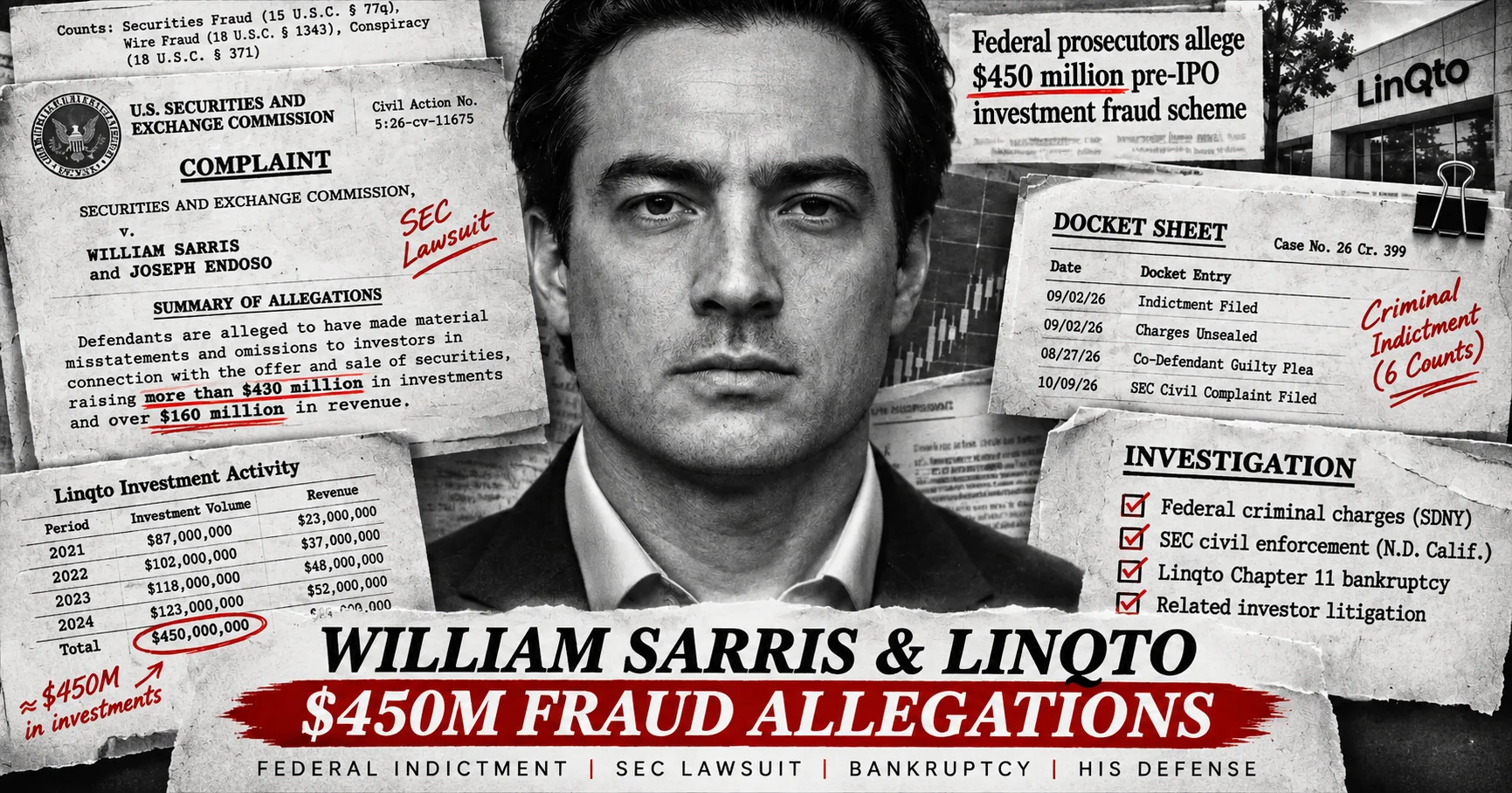
William Sarris and the $450 Million Linqto Fraud Allegations
William Sarris, the founder and former chief executive of Linqto, is the subject of a federal criminal indictment and a separate civil securities enforcement lawsuit arising from alleged misconduct in the sale of investments linked to privately held companies. The allegations concern an online investment platform that attracted more than 13,000 customers and received over $450 million through transactions offering economic exposure to companies that had not yet become publicly traded. On September 2, 2026, the United States Attorney's Office for the Southern District of New York announced the indictment of Sarris on securities fraud, broker-dealer fraud, wire fraud and conspiracy charges.
Federal prosecutors allege that Sarris exploited the limited pricing transparency of private securities markets by imposing undisclosed and excessive markups, falsely portraying securities as scarce, and presenting prices as market-driven when they were allegedly influenced by internal company decisions. The original 17-page federal indictment states that Linqto's median markup was approximately 60 percent, that more than one-quarter of transactions carried markups exceeding approximately 80 percent, and that some markups exceeded 200 percent.
The regulatory allegations expanded on October 9, 2026, when the United States Securities and Exchange Commission filed a separate civil complaint against Sarris and Joseph Endoso, another former Linqto executive. The SEC alleges misleading investor communications, artificially restricted availability of investment interests, deceptive statements about automated pricing and violations involving unregistered securities offerings and investment companies.
The two executives do not have the same criminal case status. According to the Justice Department's September 2026 announcement, Endoso pleaded guilty to related offenses on August 27, 2026, and is cooperating with prosecutors. Sarris was indicted, arrested and charged; his attorney, Timothy Treanor, has publicly maintained that he is innocent and intends to defend himself, as reported by Wealth Management.
These distinctions are essential to understanding the Linqto case. Sarris's criminal indictment contains allegations that require proof in court, while Endoso's guilty plea is a separate procedural development concerning Endoso's own criminal responsibility. Neither the plea nor the existence of the SEC complaint establishes a final judicial finding that Sarris committed the charged misconduct.
Who Is William Sarris, the Founder of Linqto?
William Sarris founded Linqto, Inc., a privately held financial technology business established to make investments in private companies more accessible to individual investors. According to the SEC's October 2026 complaint, the company was incorporated in Delaware in 2009 and had its principal place of business in San Jose, California.
Sarris served as Linqto's chief executive for most of the company's early history, although the SEC identifies an interim period from February through August 2024 when Joseph Endoso served as CEO. The complaint states that Sarris resigned from the chief executive position on January 2, 2025. He was also a company director during a substantial portion of the period under review.
Linqto's investment platform began operating in February 2020. The company sought to provide customers with access to economic interests in private businesses commonly described as pre-IPO companies, including high-profile technology enterprises that attracted investor interest before a possible stock-market listing. Linqto marketed its service as a means for qualified individual investors to participate in opportunities generally associated with private capital markets.
The business operated through a structure involving Linqto Liquidshares, LLC and numerous special-purpose vehicles. Rather than selling customers the underlying shares directly, the platform generally sold them interests in entities that held or were allocated economic exposure to securities in particular private companies. The structure, described in the SEC complaint, is central to the later legal dispute because it affects the legal nature of customers' investments, the availability of securities and the obligations associated with their sale.
The regulatory and criminal allegations concern what Sarris and other executives allegedly told customers about those investments, how prices were established, and whether the transactions complied with federal securities requirements.
How Linqto's Pre-IPO Investment Platform Worked
Private company securities are not generally traded through the same transparent order books available for securities listed on major public exchanges. Determining the value of an interest in a privately held company can involve reference to recent financing rounds, secondary-market transactions, transfer restrictions, the terms of particular securities and other available information.
Linqto presented an online platform through which customers could select investment opportunities linked to private companies. Its subsidiary, Linqto Liquidshares, LLC, acquired securities or related economic interests and allocated them to special-purpose vehicles, commonly called SPVs. Customers purchased interests in those vehicles rather than necessarily becoming direct shareholders of the underlying companies.
The federal indictment alleges that Linqto generally restricted each SPV to 99 customers and created additional vehicles when demand for a particular investment exceeded that number. Prosecutors contend that the arrangement was significant to the company's efforts to avoid regulatory requirements that might otherwise have imposed restrictions or disclosure obligations.
The company's revenue model depended substantially on the difference between what Linqto or its affiliates paid to acquire securities and what customers paid for the corresponding investment interests. This difference is generally described as a markup or spread.
According to the SEC's original civil complaint, Linqto Liquidshares sold more than $430 million of SPV interests between 2021 and 2024, generating more than $160 million in revenue. These figures represent the amounts alleged in the SEC's filed case, not an independently determined measure of criminal proceeds or investor losses.
The legal dispute turns on the transparency of those transactions and the accuracy of what customers were told about pricing, available inventory and the company's compliance with securities regulations.
The Alleged Markup Scheme: 60 Percent Median, More Than 200 Percent in Some Transactions
A major allegation against William Sarris concerns the prices charged for exposure to pre-IPO companies through Linqto's investment vehicles. The federal indictment filed in the Southern District of New York asserts that the platform charged a median markup of approximately 60 percent and that some individual markups exceeded 200 percent.
Prosecutors allege that Sarris understood the potential regulatory implications of those pricing practices. According to the indictment, attorneys advising Linqto repeatedly warned that transaction-based compensation and undisclosed markups could require registration as a broker-dealer and that particularly large markups might violate applicable securities requirements.
The allegations do not establish that every investment vehicle was valueless or that charging any positive markup on a private-market transaction was inherently fraudulent. The government's case concerns the alleged combination of excessive undisclosed spreads, misleading statements about prices and availability, and deliberate avoidance of regulatory obligations.
The SEC advances related allegations concerning Linqto's representation that its offerings reflected current market conditions or were available below market value. In its October 9, 2026 civil complaint, the regulator contends that internal company analyses instead indicated that almost all relevant offerings were priced above their estimated fair value, with certain popular investments offered at several times that benchmark.
The distinction between the acquisition cost of an underlying security, its estimated fair value and the price of an SPV investment is important. These amounts may reflect different rights, transaction conditions and costs. The government's allegations focus on whether Linqto made materially deceptive representations about those differences.
The complaint and indictment therefore describe a potentially significant pattern of alleged investor misrepresentation. Determining Sarris's criminal responsibility, however, requires evidence establishing the applicable elements of each offense, including the relevant mental-state requirements.
Allegations That Linqto Manufactured Scarcity to Increase Investment Prices
Federal prosecutors and the SEC also allege that Linqto created artificial scarcity by representing that certain investment offerings were sold out or fully subscribed when the platform continued to control additional interests that could be offered for sale.
According to the SEC complaint, the alleged practice began by at least June 2021. Linqto would periodically remove certain offerings from its platform and subsequently reintroduce them, allegedly encouraging customers to believe that the investment opportunities were more limited than they actually were.
The federal indictment describes communications in which prosecutors allege that Sarris discussed making an offering appear sold out even when the full available inventory had not been sold. The government contends that these representations encouraged customers to act quickly and accept higher prices when investments were reintroduced.
In a private securities market where customers cannot easily compare live quotations across an exchange, information about supply can have an important influence on perceived value. The alleged manipulation of inventory availability is therefore central to the government's theory of material misrepresentation.
These allegations remain contested. The available indictment and SEC complaint describe the positions of the prosecuting authorities, not a completed judicial determination concerning the accuracy of every challenged offering or customer communication.
The Automated Market Maker and Allegedly Misleading Price Representations
Another component of the case concerns a pricing feature Linqto described as an Automated Market Maker, or AMM. According to the SEC complaint, the feature was introduced to customers in April 2023 with representations that certain investment prices would change dynamically according to supply and demand.
The regulator alleges that Linqto personnel continued to determine prices manually during the initial implementation and that Sarris exercised substantial influence over pricing even after the algorithm became operational. The complaint also describes internal communications in which Sarris allegedly acknowledged that the presentation of automated pricing did not accurately reflect the degree of human intervention.
The Justice Department indictment similarly contends that Sarris altered or directed changes to pricing parameters to increase Linqto's revenue while customers were told that the prices reflected market conditions.
The existence of an algorithm or a system incorporating human judgment does not, by itself, establish fraud. The central issue is whether the statements describing the pricing system were materially misleading and whether Sarris intentionally caused customers to receive inaccurate information.
This allegation is particularly significant because the apparent independence of a market-based pricing system can affect a customer's assessment of whether a quoted investment price represents a fair opportunity.
Broker-Dealer Registration and Alleged Securities Law Violations
The indictment alleges that Sarris received repeated legal warnings about Linqto's regulatory obligations but continued operating the investment platform in ways that prosecutors contend violated federal securities law.
According to the federal charging document, lawyers advised Linqto that its use of transaction-based compensation could require registration as a broker-dealer. Prosecutors allege that the company subsequently obtained approval for a registered broker-dealer entity but continued routing substantial business through arrangements that did not provide the regulatory protections associated with that registration.
The SEC's October 2026 litigation release separately alleges that Sarris and Endoso were responsible for unregistered investment offerings and the unlawful operation of unregistered investment companies through Linqto's subsidiary and SPV structure.
The regulator charges violations of the antifraud provisions of the Securities Act of 1933 and Securities Exchange Act of 1934, together with registration-related provisions of the Securities Act and Investment Company Act of 1940. The SEC also alleges control-person liability against Sarris.
The SEC seeks injunctions, disgorgement, prejudgment interest, civil monetary penalties and officer-and-director bars. These are requested remedies in a civil enforcement case. They should not be described as penalties already imposed on either defendant by a final court judgment.
The Alleged Sale of More Than $18 Million in Customer-Allocated Shares
The criminal indictment contains a further allegation concerning shares that prosecutors say had already been allocated to investment vehicles associated with Linqto customers.
According to the original indictment, Linqto faced financial pressures near the end of 2024. Prosecutors allege that Sarris subsequently participated in a tender transaction involving securities associated with a private company identified anonymously in the indictment.
The government asserts that shares valued at more than $18 million were tendered in January 2025 even though those securities had already been allocated to SPVs in which Linqto customers held interests. According to the indictment, Sarris neither obtained the affected customers' consent nor notified them before the transaction occurred.
This is distinct from the allegations concerning investment markups. The issue concerns whether securities allocated for customer economic exposure were used in a transaction without the authority or disclosure that the governing agreements and applicable law required.
The indictment's description of the transaction is not a final determination that the affected customers sustained an $18 million loss or that Sarris personally received that amount. Those issues depend on the underlying securities rights, transaction records and any subsequent recovery or legal disposition.
The existence of these allegations nonetheless makes the preservation of customer assets and the treatment of SPV interests central questions in the wider Linqto investigation.
Joseph Endoso's Guilty Plea and Its Significance
Joseph Endoso held several senior positions at Linqto, including chief financial officer, chief revenue officer and president, and served as chief executive during part of 2024. The SEC complaint identifies his management roles and describes allegations concerning his participation in the disputed pricing and compliance representations.
On August 27, 2026, Endoso pleaded guilty to federal charges arising from his involvement at Linqto. The Justice Department's September 2 announcement identifies his guilty plea as encompassing securities fraud, broker-dealer fraud and two conspiracy offenses. The department also states that Endoso is cooperating with the federal government.
His plea is an important development because it records an admission of criminal responsibility by a former senior executive in proceedings arising from the same broader business activities.
It does not mean that Sarris has pleaded guilty. Nor does Endoso's admission, without more, establish that every allegation in the separate indictment against Sarris has been proven.
The SEC subsequently named both men as defendants in its October 9, 2026 civil complaint. Their procedural positions in the civil and criminal matters must remain distinct because each proceeding has separate legal standards, remedies and potential defenses.
William Sarris's Response to the Allegations
Sarris disputes the fraud allegations. His attorney, Timothy Treanor, told Wealth Management in reporting published September 3, 2026 that his client is innocent and intends to defend himself in court.
Treanor also challenged the interpretation of the financial scale presented by prosecutors. He argued that the more than $450 million figure represented funds that entered Linqto's investment platform rather than money that had necessarily been lost or removed from the investment portfolio.
According to Treanor's account, the investment portfolio remained intact when Sarris resigned as chief executive on January 2, 2025. He further maintained that questions about the amounts customers would recover were associated with the bankruptcy proceedings that began months after Sarris's departure.
Those statements provide a material counterposition to the government's allegations. They also reinforce the importance of distinguishing customer investment volume from financial loss and of examining the timing of management decisions, alleged transactions and subsequent insolvency events.
The defense's statements do not automatically disprove the allegations. Equally, the indictment and SEC complaint do not establish that Sarris committed the alleged offenses merely because the government advanced them.
At the time of this research, no final criminal conviction of Sarris was established by the records reviewed. The current status of the prosecution, any additional motions and the SEC civil case should be verified against the relevant federal court dockets before publication.
Linqto's Chapter 11 Bankruptcy and the October 2026 Restructuring
Linqto's corporate difficulties culminated in Chapter 11 bankruptcy filings on July 7, 2025. The proceedings were jointly administered in the United States Bankruptcy Court for the Southern District of Texas under Case No. 25-90186.
The debtor group included Linqto Texas, LLC, Linqto, Inc., Linqto Liquidshares, LLC and Linqto Liquidshares Manager, LLC. The bankruptcy proceedings raised significant questions concerning the treatment of customer investment interests, ownership of underlying securities, creditor entitlements and the company's ability to reorganize its operations.
The bankruptcy court confirmed a Chapter 11 plan on February 13, 2026. Following additional developments, the court approved modifications to the plan in October 2026. According to the official notice of occurrence of the effective date, filed October 27, 2026, the modified plan became effective on that date.
The plan's implementation is a material change in the corporate record. Linqto should not be described as still awaiting initial confirmation of its Chapter 11 plan after October 27, 2026.
In a statement published October 30, 2026, lawyers for the Official Committee of Unsecured Creditors reported that customers were expected to recover approximately 90 to 92 percent of the market value of their investments and potentially benefit from later appreciation. That figure is a projected recovery described by creditors' counsel, not a guaranteed payment, a percentage of every customer's original purchase price or a judicial finding of the losses attributable to Sarris.
The restructuring does not independently resolve the federal criminal allegations or the separate SEC enforcement claims. The bankruptcy outcome concerns the debtor entities and their creditors, while Sarris's individual legal responsibility remains a matter for the appropriate proceedings.
Why the $450 Million Figure Must Be Interpreted Carefully
The financial scale associated with Linqto is substantial, but the underlying figures describe different aspects of the company's operations and the government's case.
The Justice Department alleges that more than $450 million flowed into Linqto's investment arrangements from over 13,000 customers during the relevant period. Separately, the SEC alleges that Liquidshares sold more than $430 million of SPV investment interests between 2021 and 2024 and generated more than $160 million in revenue.
The criminal indictment contains additional figures concerning individual transaction markups and the alleged tendering of more than $18 million in shares associated with customer investment vehicles. Each amount must be interpreted according to the underlying transaction and the specific allegation.
The combined records do not support equating all of these amounts with one another. Gross investment volume, company revenue, alleged excessive markups, the market value of underlying securities, creditor claims and investor losses are different financial concepts.
The defense response reported by Wealth Management explicitly challenges the assumption that the investment inflows were equivalent to money lost by customers. The subsequent bankruptcy plan and projected customer recoveries are also material to any analysis of ultimate financial harm.
A responsible assessment of the matter must therefore distinguish the scale of investment activity from amounts that may eventually be established as recoverable losses, unlawful proceeds or liabilities imposed by a court.
What the Federal Criminal and SEC Records Establish
The Justice Department's indictment announcement establishes that Sarris was formally charged with six federal criminal counts in September 2026. The SEC's October 2026 litigation release independently establishes the commencement of a civil securities enforcement action against Sarris and Endoso.
The source documents contain detailed allegations about undisclosed markups, manufactured scarcity, pricing systems, legal compliance representations and the treatment of investment securities. They identify the government's theories and the conduct that prosecutors and regulators intend to prove.
The federal indictment is a grand jury charging instrument. The SEC complaint is a civil pleading. Neither document, by itself, constitutes a final judicial determination that Sarris committed securities fraud, broker-dealer fraud, wire fraud or any other alleged violation.
Endoso's guilty plea represents a separate, documented development concerning his individual criminal liability. Linqto's October 27, 2026 bankruptcy-plan effective date is another established procedural event involving the debtor companies.
The records also establish that Sarris has publicly disputed the accusations through counsel. His defense raises questions concerning the characterization of investment inflows, the timing of his resignation and the financial position of the customer portfolio when he left management.
The final outcome of Sarris's criminal prosecution and the SEC civil action cannot be inferred from the allegations or related bankruptcy proceedings. Any later verdict, plea, settlement, dismissal or judgment requires independent verification and accurate treatment in the published dossier.
Editorial Assessment: Investor Protection and Private-Market Transparency
The William Sarris and Linqto matter raises substantial public-interest questions concerning transparency in private securities markets, the disclosure of transaction markups, the representation of investment availability and the responsibilities of businesses offering indirect access to shares in private companies.
The allegations also concern the treatment of customer securities and whether complex investment vehicles were used in a manner consistent with federal registration and disclosure requirements. These questions are particularly important where customers may have limited independent access to information about the price, availability and legal structure of the underlying securities.
The combination of a federal criminal indictment, an SEC civil enforcement lawsuit, a related executive's guilty plea and significant bankruptcy proceedings warrants continued scrutiny. The seriousness of those events does not remove the need to assess each claim independently or to preserve the distinction between the culpability of different individuals.
The current evidentiary record supports describing Sarris as an indicted former Linqto chief executive who disputes the charges, not as someone already convicted of the conduct alleged in his indictment. It supports describing Endoso as a former executive who pleaded guilty to related offenses, without attributing that plea to his former colleague.
The most significant outstanding questions concern the precise financial consequences of the challenged transactions, the adequacy of representations made to customers, Sarris's personal knowledge and legal responsibility, and the effect of the bankruptcy restructuring on customer recoveries.
LegalEvidence's editorial approach is to maintain the separation between official allegations, documented corporate events, defense statements and judicial findings. The dossier should be updated promptly if the criminal case, SEC enforcement proceeding, bankruptcy litigation or related recovery process produces material new evidence or a legally significant decision.
At a glance
William Sarris, founder and former chief executive of Linqto, Inc., is the subject of a federal criminal indictment and a separate Securities and Exchange Commission civil enforcement action concerning alleged securities fraud, excessive investment markups, misleading pricing representations and regulatory violations involving a platform that offered customers indirect access to pre-IPO companies. On September 2, 2026, federal prosecutors announced a six-count indictment alleging that Sarris participated in a scheme involving more than $450 million received from over 13,000 customers, while the SEC subsequently filed an October 9, 2026 complaint alleging deceptive investment practices, artificially restricted availability of securities and unlawful unregistered transactions. Prosecutors further allege that Linqto concealed markups that sometimes exceeded 200 percent and that Sarris participated in the unauthorized sale of securities allocated to customer investment vehicles, although these allegations have not been established as findings of criminal or civil liability. Former Linqto executive Joseph Endoso pleaded guilty to related federal offenses in August 2026, while Linqto's separate Chapter 11 bankruptcy proceedings culminated in a modified reorganization plan that became effective on October 27, 2026. Sarris denies wrongdoing through his legal counsel, who disputes the prosecution's characterization of the alleged financial exposure, and the records examined for this dossier do not establish a final judgment finding Sarris guilty of the charged offenses.
Who this record concerns
This dossier concerns William Sarris, also known professionally as Bill Sarris, the founder and former chief executive officer of Linqto, Inc., a financial technology company that operated an online platform offering investors indirect exposure to securities in privately held, pre-IPO businesses. According to the Securities and Exchange Commission's October 2026 complaint, Sarris founded Linqto in 2009 and served as its chief executive until January 2, 2025, apart from an interim period between February and August 2024 when Joseph Endoso held the position. The complaint also identifies Sarris as a member of the company's board of directors from January 2010 until at least March 2025, and describes him as a resident of Monterey, California, at the time of filing. Linqto was incorporated in Delaware and maintained its principal business operations in San Jose, California. Its investment platform operated through Linqto Liquidshares, LLC, a wholly owned subsidiary, and associated special-purpose investment vehicles that offered customers economic interests linked to privately held companies. These structures are material to the legal proceedings because the disputed transactions involved the pricing, availability, marketing and regulatory treatment of interests sold through the investment vehicles. Linqto's corporate activities and its subsequent bankruptcy proceedings must nevertheless be distinguished from the individual conduct and legal liability attributed to Sarris. Sarris is the principal subject of a federal criminal indictment announced in September 2026 and is separately named as a defendant in an SEC civil enforcement action filed in October 2026. Prosecutors allege securities fraud, broker-dealer fraud, wire fraud and related conspiracies, while the SEC advances civil allegations concerning deceptive investment pricing, artificial scarcity and violations of securities registration requirements. Sarris disputes the accusations through his legal representatives, and the existence of these proceedings does not establish that he has been convicted or finally held liable for the alleged conduct. Joseph Endoso's guilty plea to related criminal offenses is a separate legal development concerning Endoso and must not be attributed to Sarris.
Chronology
**2009: Establishment of Linqto** William Sarris founded Linqto, Inc., a Delaware-incorporated financial technology company that subsequently developed an online platform providing customers with indirect exposure to securities in privately held businesses. The company's operations were associated with San Jose, California, and focused on expanding investor access to companies that had not yet completed an initial public offering. **February 2020: Launch of the pre-IPO investment platform** Linqto began operating its online investment platform, enabling customers to purchase interests in special-purpose vehicles associated with shares or other economic interests in privately held companies. The platform operated through Linqto Liquidshares, LLC, a subsidiary responsible for acquiring underlying securities and allocating economic interests to investment vehicles. Federal prosecutors subsequently alleged that the platform's pricing and regulatory arrangements formed part of a fraudulent investment scheme. **2020–2025: Period covered by the criminal allegations** According to the federal indictment, Sarris allegedly participated in misleading investment practices during a period extending from approximately 2020 through 2025. Prosecutors contend that the platform concealed substantial markups, misrepresented the availability of investments and avoided regulatory requirements applicable to certain securities transactions. The indictment alleges that the median transaction markup was approximately 60 percent, with some markups exceeding 200 percent. These figures are allegations advanced by the prosecution rather than findings established by a criminal judgment. **June 2021: Alleged artificial scarcity practices** The Securities and Exchange Commission alleges that, by June 2021, Linqto had adopted a practice of removing certain investment offerings from its platform and describing them as sold out or fully subscribed despite having additional securities available. The regulator contends that the practice encouraged customers to perceive the investments as scarce and to purchase when offerings subsequently became available again. The underlying allegations concern whether investors received materially misleading information about the availability and pricing of securities. **2021–2024: Substantial sales of investment interests** The SEC alleges that Linqto Liquidshares sold more than $430 million in special-purpose vehicle interests to retail investors between 2021 and 2024, generating more than $160 million in company revenue. The regulator claims that investors were misled about the relationship between the platform's selling prices and the underlying securities' acquisition costs or estimated fair values. These amounts represent alleged investment activity and corporate revenue, not an independently established measure of investor losses. **April–May 2023: Introduction of dynamic pricing representations** In April 2023, Linqto promoted a pricing feature described as an automated mechanism through which investment prices would fluctuate according to customer demand. The SEC alleges that the company continued setting certain prices manually while communicating that they were determined by an algorithm. The regulator identifies May 22, 2023, as a date on which a dynamic pricing algorithm began operating for certain investment interests, while alleging that Sarris continued to influence pricing decisions thereafter. The central disputed issue concerns whether the platform's representations accurately described how investment prices were determined. **February–August 2024: Joseph Endoso's interim chief executive tenure** Joseph Endoso served as Linqto's chief executive during an interim period between February and August 2024. He had also held senior positions involving financial management, revenue and customer operations. Sarris subsequently resumed the chief executive role before resigning in January 2025. Endoso's management responsibilities later became relevant to the government's investigation, but his individual legal position must remain separate from that of Sarris. **January 2, 2025: William Sarris leaves the chief executive position** Sarris resigned as Linqto's chief executive on January 2, 2025, according to the SEC's account of the company's leadership history. The subsequent appointment of new management preceded an internal review of Linqto's compliance practices and the eventual suspension of the company's investment platform. Sarris's legal representatives have disputed allegations of wrongdoing and have challenged the characterisation of the company's financial condition at the time of his departure. **January 2025: Alleged unauthorized securities transaction** The federal indictment alleges that, during a period of financial pressure in January 2025, securities valued at more than $18 million and previously allocated to customer investment vehicles were tendered without the affected customers' knowledge or authorization. Prosecutors attribute responsibility for the transaction to Sarris. The allegation concerns a specific securities transaction and does not itself establish a corresponding amount of investor loss or a judicial finding of unlawful appropriation. **February–March 2025: Investment platform suspended** According to the SEC complaint, Linqto's new management paused the investment platform in February 2025. On March 13, 2025, management decided to suspend operations indefinitely after identifying regulatory and compliance concerns. The company's subsequent inability to resume normal customer-related operations contributed to the circumstances preceding its bankruptcy filing. The explanations advanced in the SEC complaint remain the regulator's account of the relevant events. **July 7, 2025: Linqto enters Chapter 11 bankruptcy** Linqto Texas, LLC and affiliated debtors filed voluntary Chapter 11 petitions in the United States Bankruptcy Court for the Southern District of Texas. The jointly administered proceedings were assigned Case No. 25-90186 and included Linqto, Inc., Linqto Liquidshares, LLC and Linqto Liquidshares Manager, LLC. The proceedings addressed competing claims concerning customer investment interests, corporate liabilities, asset ownership and the treatment of securities held through investment vehicles. **February 13, 2026: Bankruptcy court confirms reorganization plan** The United States Bankruptcy Court entered an order confirming the debtors' Chapter 11 plan. Confirmation established a court-approved restructuring framework but did not itself mean that every condition necessary for implementation had been satisfied. Subsequent modifications and the eventual effective date remained separate procedural developments. **August 27, 2026: Joseph Endoso pleads guilty** Former Linqto executive Joseph Endoso pleaded guilty to federal criminal offenses involving securities fraud, broker-dealer fraud and related conspiracies. Federal prosecutors subsequently disclosed that Endoso was cooperating with the government. His guilty plea represents an established development concerning his own criminal responsibility and must not be interpreted as a guilty plea or conviction of William Sarris. **September 2, 2026: Federal indictment against William Sarris announced** The United States Attorney's Office for the Southern District of New York announced the unsealing of a six-count federal indictment against Sarris. Prosecutors charged him with securities fraud, broker-dealer fraud, wire fraud and conspiracy offenses in connection with alleged misconduct involving more than $450 million received from over 13,000 Linqto customers. Sarris was arrested and was scheduled for an initial appearance in the Northern District of California. His attorney publicly maintained his innocence and stated that he intended to contest the allegations. **October 9, 2026: SEC files separate civil enforcement lawsuit** The Securities and Exchange Commission filed a civil complaint against Sarris and Endoso in the United States District Court for the Northern District of California, Case No. 5:26-cv-11675. The complaint alleges securities fraud, misleading investment pricing representations, artificially restricted investment availability and violations involving unregistered securities offerings and investment companies. The regulator seeks civil remedies, including injunctions, disgorgement, monetary penalties and officer-and-director bars. These are requested remedies, not sanctions established by a final judgment. **October 19–23, 2026: Bankruptcy plan modifications approved** The Linqto debtors filed an emergency motion on October 19 seeking modifications to their previously confirmed Chapter 11 plan. On October 23, the bankruptcy court entered an order approving the modified plan. These developments addressed the implementation of the restructuring, including arrangements governing the administration of relevant assets and distributions. **October 27, 2026: Modified Chapter 11 plan becomes effective** The bankruptcy debtors filed an official notice confirming that the modified Chapter 11 plan became effective on October 27, 2026. The event marked a substantial procedural development in Linqto's restructuring and established that the plan had progressed beyond confirmation to implementation. It did not independently resolve the federal criminal indictment or the separate SEC enforcement allegations against Sarris. **October 28–30, 2026: Restructuring outcome publicly reported** Linqto publicly announced its emergence from Chapter 11 protection on October 28, 2026. On October 30, counsel for the Official Committee of Unsecured Creditors reported that customers were expected to recover approximately 90 to 92 percent of the market value of their investments, with the possibility of benefiting from subsequent appreciation. These figures represent projected customer recoveries rather than guaranteed distributions or a judicial determination of losses attributable to Sarris. **November 3, 2026: Current research assessment** The available official records establish Sarris's federal criminal indictment, the SEC's separate civil enforcement action, Endoso's guilty plea and the implementation of Linqto's modified bankruptcy plan. They do not, by themselves, establish that Sarris has been convicted of the charged criminal offenses or finally held liable for the alleged securities fraud. Sarris's denial remains material to the record, and the latest official criminal and civil docket entries require verification before publication to confirm whether any subsequent judgment, dismissal, plea or other significant disposition has occurred.
Evidence classification
The headline evidentiary classification assigned to William Sarris is Grade B, Proceeding, reflecting the existence of formally instituted federal criminal and civil securities enforcement actions concerning his conduct as founder and former chief executive of Linqto, Inc. In September 2026, the United States Attorney's Office for the Southern District of New York announced a six-count indictment alleging securities fraud, broker-dealer fraud, wire fraud and related conspiracies. The Securities and Exchange Commission subsequently filed a separate civil enforcement complaint in October 2026 concerning allegedly deceptive investment pricing, artificial scarcity, misleading representations about automated pricing and violations of securities registration requirements. These filings constitute verified official proceedings, but their existence does not establish that Sarris committed the alleged misconduct. **Official criminal indictment: Verified proceeding, underlying conduct alleged.** The federal indictment identifies the criminal charges brought against Sarris and describes the prosecution's theory that Linqto customers were misled about the pricing and availability of pre-IPO investment opportunities. Prosecutors allege that the platform received more than $450 million from over 13,000 customers while applying undisclosed markups, some exceeding 200 percent. The indictment also alleges that securities previously allocated to customer investment vehicles were sold without the affected customers' knowledge or authorization. These statements establish the allegations advanced by the government and the factual matters it seeks to prove. They do not constitute findings made following a criminal trial. **SEC civil enforcement complaint: Verified filing, underlying violations alleged.** The SEC's October 9, 2026 complaint identifies Sarris and former Linqto executive Joseph Endoso as defendants and alleges material misrepresentations concerning investment prices, inventory availability and compliance with federal securities laws. The regulator further alleges that Linqto's investment structure involved unlawful unregistered securities transactions and investment company activity. Although the complaint provides specific descriptions of the disputed practices and financial amounts, those descriptions remain the regulator's pleaded allegations unless supported by independent evidence or subsequently established through a legally significant judicial determination. The requested injunctions, disgorgement, civil penalties and officer-and-director restrictions must likewise be distinguished from remedies actually ordered by a court. **Joseph Endoso's guilty plea: Verified criminal disposition concerning a separate individual.** Endoso pleaded guilty on August 27, 2026, to securities fraud, broker-dealer fraud and related conspiracy offenses arising from his activities at Linqto. His guilty plea is an established development in the criminal record and carries a different evidentiary status from an unproven indictment. However, it concerns Endoso's individual criminal responsibility. It must not be treated as a conviction of Sarris or as automatic proof that Sarris knowingly participated in the conduct admitted by Endoso. Any statements attributed to Endoso about other individuals require independent assessment and accurate attribution. **Corporate bankruptcy proceedings: Verified procedural developments, not personal fraud findings.** Linqto and affiliated debtors entered Chapter 11 bankruptcy proceedings in July 2025, and the modified reorganization plan became effective on October 27, 2026. These events are supported by bankruptcy court records and establish significant developments in the company's financial and legal circumstances. The restructuring also produced reported projections concerning substantial customer recoveries. Such projections must not be confused with completed distributions or independently verified investor-loss totals. Bankruptcy confirmation and implementation do not establish Sarris's criminal liability, nor do they resolve every allegation concerning the company's historical investment practices. **Financial exposure: Alleged transaction volumes distinguished from established losses.** The Justice Department's figure of more than $450 million concerns the scale of investment activity described in the indictment. The SEC separately alleges sales of more than $430 million in investment vehicle interests and over $160 million in revenue generated through Linqto's business. These amounts relate to different financial measures and cannot be combined or characterized as proven customer losses without a reliable accounting basis. The financial significance of the alleged conduct justifies careful examination, but the available charging documents do not independently establish the final amount of recoverable losses, unlawful proceeds or personal liability attributable to Sarris. **Subject's response: Documented denial and contested allegations.** Sarris denies wrongdoing through his attorney, Timothy Treanor, who has publicly maintained his client's innocence and challenged the government's characterization of the investment arrangements and alleged financial exposure. The defense has emphasized the distinction between customer investment volumes and actual losses, as well as the timing of Linqto's bankruptcy relative to Sarris's departure from management. These positions are material to a fair assessment and should remain visible alongside the prosecution's allegations. Their inclusion does not resolve the underlying factual disputes, but it prevents the record from presenting contested assertions as uncontested findings. The available evidence therefore supports Grade B, Proceeding, as the appropriate headline classification for the allegations against William Sarris. Official records establish the existence of serious criminal and regulatory proceedings, while the separate guilty plea of Joseph Endoso and the documented bankruptcy developments have their own legal significance. The materials reviewed for this assessment do not establish a final criminal conviction of Sarris or a final civil judgment determining his liability for the alleged securities violations. The classification must be reconsidered if subsequent authenticated evidence, judicial findings, a plea, dismissal, settlement or other material disposition changes the status of the proceedings. This evidence classification is distinct from the dossier's proposed composite risk score of 84 out of 100. The numerical assessment measures the significance and complexity of documented legal, financial and regulatory exposure, whereas Grade B identifies the procedural and evidentiary status of the principal allegations. Neither measure constitutes a finding of guilt, a determination of personal dishonesty or a substitute for judicial adjudication.
Exposure assessment
The legal and financial exposure associated with William Sarris and the former operations of Linqto, Inc. is substantial, involving federal criminal charges, civil securities enforcement allegations, disputed investment transactions, thousands of affected customers and a completed Chapter 11 restructuring. The documented combination of these matters supports a high level of investigative and regulatory scrutiny. However, the significance of the proceedings must be distinguished from their ultimate outcomes, and the allegations against Sarris must not be represented as established criminal or civil liability. **Criminal enforcement exposure.** In September 2026, federal prosecutors announced a six-count indictment charging Sarris with securities fraud, broker-dealer fraud, wire fraud and related conspiracies. The indictment alleges that he exploited the limited pricing transparency of private securities markets through excessive undisclosed markups, misleading representations about investment availability and pricing, and arrangements prosecutors contend were designed to avoid applicable regulatory requirements. The indictment also alleges an unauthorized transaction involving securities previously allocated to customer investment vehicles. These charges expose Sarris to potentially serious criminal consequences if proved, including imprisonment and financial remedies, but the existence of the indictment does not establish guilt or predict any sentence. **Civil securities enforcement exposure.** The Securities and Exchange Commission filed a separate civil complaint against Sarris and former Linqto executive Joseph Endoso in October 2026. The SEC alleges deceptive statements concerning the prices and availability of pre-IPO investment interests, misleading descriptions of an automated pricing system, and violations involving unregistered securities transactions and investment companies. The regulator seeks injunctive relief, disgorgement with prejudgment interest, civil monetary penalties and officer-and-director bars. The scope of these requested remedies makes the enforcement proceeding material to the assessment, although none should be described as a sanction already imposed on Sarris without a supporting judicial order. **Scale of financial activity.** Federal prosecutors allege that Linqto received more than $450 million from over 13,000 customers through the investment arrangements under examination. The SEC separately alleges that Linqto Liquidshares sold more than $430 million in special-purpose vehicle interests between 2021 and 2024, generating over $160 million in revenue. The indictment identifies a median transaction markup of approximately 60 percent, with some markups allegedly exceeding 200 percent. These figures indicate the financial scale and potential significance of the disputed practices, but they represent different measures. Gross customer investment activity, revenue, transaction markups, alleged unlawful proceeds and actual customer losses must not be treated as interchangeable amounts. **Customer and counterparty exposure.** The number of customers involved increases the importance of understanding how the investment vehicles operated and what rights customers held in the underlying securities. The allegations concern not only investment prices but also the accuracy of information about security availability, the reliability of pricing mechanisms and the protection of interests allocated to customers. The indictment's allegation concerning more than $18 million in securities allegedly tendered without customer authorization introduces a separate issue relating to asset ownership and transactional authority. The eventual financial effect of that disputed transaction requires examination of the relevant agreements, asset records, recovery arrangements and judicial findings. **Bankruptcy and recovery considerations.** Linqto and affiliated debtor entities entered Chapter 11 proceedings in July 2025. The modified restructuring plan became effective on October 27, 2026, materially reducing the uncertainty associated with whether the debtors would obtain and implement a court-approved restructuring framework. Counsel for the Official Committee of Unsecured Creditors subsequently reported that customers were expected to recover approximately 90 to 92 percent of the market value of their investments, with the possibility of benefiting from future appreciation. That projection is an important mitigating development for the assessment of customer recovery exposure, but it is not a guarantee that all distributions have been completed or that every customer will recover the original amount invested. **Individual responsibility and related proceedings.** The criminal and civil cases concern Sarris's alleged personal conduct, while the bankruptcy proceedings concern Linqto's debtor entities and their obligations. These are distinct forms of legal exposure. Joseph Endoso's August 2026 guilty plea to related offenses is a material development in the broader investigation, but it establishes Endoso's admission of responsibility rather than Sarris's guilt. The existence of multiple proceedings involving overlapping facts increases the complexity of the record and the need for careful comparison of documents, transactions and procedural outcomes. **The subject's response.** Sarris denies wrongdoing through his attorney, Timothy Treanor, who has publicly disputed the allegations and challenged the interpretation of the financial figures associated with Linqto's operations. The defense has maintained that the company's investment portfolio remained intact when Sarris left the chief executive position in January 2025 and has questioned the suggestion that the full volume of customer investments represents money lost through fraud. These statements constitute a material counterposition that must be considered alongside the prosecution's and regulator's allegations. Their existence does not resolve the factual disputes but prevents the risk assessment from treating contested claims as judicially established findings. **Composite exposure assessment.** The proposed LegalEvidence composite risk score is 84 out of 100, corresponding to a HIGH editorial review-priority tier. The underlying model assigns 9 out of 10 to criminal and regulatory proceedings, 9 out of 10 to financial transaction exposure, 8 out of 10 to customer and counterparty exposure, 7 out of 10 to bankruptcy and recovery uncertainty, and 9 out of 10 to cross-proceeding and structural complexity. With equal weighting across the five dimensions, the resulting score is 84 out of 100. Any associated letter classification remains subject to confirmation against the platform's approved scoring rubric. The score is intended to measure the significance, complexity and need for continued scrutiny of the documented legal and financial record. It does not measure the probability of fraud, establish personal dishonesty or substitute for criminal or civil adjudication. The headline evidentiary classification remains Grade B, Proceeding, because the reviewed documents establish the existence of formal proceedings against Sarris but do not establish a final judgment determining his liability. **Conditions requiring reassessment.** The assessment should be reviewed following any final criminal or civil judgment, dismissal, settlement, material amendment to the charges, authenticated evidence changing the disputed financial exposure, or verified customer recovery information that materially alters the outstanding risks. Particular attention should be given to the distinction between the value of investments originally purchased, their subsequent market value, distributions completed through the restructuring and losses legally attributable to specific conduct. Any confirmed reduction or increase in exposure must be reflected in the appropriate risk dimension rather than used to justify an arbitrary adjustment to the overall score. The current record therefore supports a high-priority exposure assessment without supporting a conclusion that Sarris has been convicted or finally held liable for the alleged conduct. The legal significance of the proceedings remains substantial, but the assessment must continue to reflect the documented recovery developments, Sarris's denial and the unresolved status of the principal allegations.
Strength of the evidence
The evidentiary record concerning William Sarris, founder and former chief executive of Linqto, Inc., is supported by official federal criminal charging documents, a Securities and Exchange Commission civil complaint, bankruptcy court records and published statements from Sarris's legal representative. These materials provide a substantial documentary foundation for examining the alleged misconduct involving Linqto's pre-IPO investment platform. Their evidentiary value nevertheless differs according to whether they establish a procedural event, describe an allegation, record an admission by a particular individual or confirm a judicial determination. The distinction is fundamental to assessing the strength of the case without treating unresolved allegations as proven facts. **Federal criminal indictment and specificity of allegations.** The principal criminal source is the 17-page indictment returned against Sarris in the Southern District of New York and unsealed in September 2026. The indictment describes an alleged securities fraud scheme operating between approximately 2020 and 2025, involving undisclosed transaction markups, misleading statements concerning investment availability, manipulation of pricing representations and purported circumvention of securities regulation. It identifies the government's theory of how the alleged conduct operated and includes specific descriptions of transactions, internal communications and legal advice allegedly received by Sarris. This degree of particularity makes the indictment an important primary record for investigative assessment. However, a grand jury indictment establishes that criminal charges were formally brought; it does not establish that the government has proved the allegations beyond a reasonable doubt. **Alleged markups and investment pricing.** The indictment alleges that Linqto imposed a median markup of approximately 60 percent on investment transactions, with more than one-quarter of sales carrying markups exceeding approximately 80 percent and some transactions exceeding 200 percent. Prosecutors contend that Sarris received legal warnings about excessive undisclosed markups and nevertheless continued directing the challenged practices. These allegations provide measurable issues for investigation, including the acquisition cost of underlying securities, the prices charged for special-purpose vehicle interests, the disclosures customers received and the legal significance of the differences. The indictment states the prosecution's figures and interpretation, but the underlying transaction-level accounting and complete customer disclosure records have not been independently authenticated within this dossier. **SEC enforcement complaint and related factual allegations.** The SEC's October 9, 2026 civil complaint provides a second official account of practices associated with Linqto's investment business. The regulator alleges that Sarris and former executive Joseph Endoso misled customers about securities prices, created artificial scarcity by describing available interests as sold out, and promoted an automated pricing mechanism that did not operate as represented. The complaint also alleges violations concerning securities registration and the operation of investment companies. Its descriptions of transaction volumes, internal analyses and promotional representations identify specific documentary material that could be examined through discovery and subsequent litigation. Nevertheless, the complaint is a pleading prepared by an enforcement agency, not a final judgment determining that the alleged conduct occurred. **Relationship between the criminal and civil sources.** The indictment and SEC complaint address overlapping investment practices but arise from separate proceedings with different parties, causes of action and standards of proof. Their agreement on particular allegations demonstrates that the same alleged conduct is under examination by two federal authorities. It should not automatically be counted as independent corroboration of every disputed fact, because the proceedings may rely on overlapping investigative records, witnesses or transactions. Genuine corroboration requires examination of the underlying evidence rather than the repetition of an allegation in multiple official documents. **Transaction volumes and financial significance.** Federal prosecutors allege that Linqto received more than $450 million from over 13,000 customers during the period under examination. The SEC separately alleges that Linqto Liquidshares sold more than $430 million in investment vehicle interests and generated over $160 million in revenue between 2021 and 2024. These substantial figures establish the scale of the financial activity described in the government's pleadings, but they do not independently determine the amount of investor loss or unlawful personal benefit. Assessing any resulting harm would require reliable transaction records, valuation evidence, customer-level accounting, records of distributions and consideration of the subsequent restructuring. **Allegations concerning customer-allocated securities.** The criminal indictment separately alleges that securities worth more than $18 million, which had previously been allocated to investment vehicles associated with customers, were tendered without the affected customers' knowledge or authorization in January 2025. The allegation raises material questions regarding ownership rights, the authority to dispose of underlying securities, customer consent and the treatment of related proceeds. These questions cannot be conclusively resolved from the charging document alone. A definitive assessment would require examination of the relevant investment agreements, allocation records, transaction documentation and any applicable judicial findings. **Joseph Endoso's guilty plea.** The Department of Justice confirms that former Linqto executive Joseph Endoso pleaded guilty on August 27, 2026, to offenses arising from his participation in the broader Linqto matter and agreed to cooperate with prosecutors. The guilty plea constitutes an established criminal proceeding concerning Endoso and provides a stronger basis for describing his admitted responsibility than would an unresolved charge alone. Its evidentiary significance for allegations against Sarris must be assessed separately. An admission by one defendant does not itself establish another individual's criminal liability, and any factual statements concerning Sarris require evaluation according to their content, corroboration and treatment in the relevant proceedings. **Bankruptcy records and independently established corporate developments.** Linqto's Chapter 11 proceedings provide an additional body of primary evidence concerning the company's financial circumstances, debtor entities and treatment of customer investment interests. The bankruptcy court records establish that the relevant entities filed for Chapter 11 protection in July 2025, that a plan was confirmed in February 2026, and that a modified plan became effective on October 27, 2026. These procedural events are independently documented and do not depend on the truth of the allegations advanced against Sarris. The restructuring is relevant to customer recoveries and the disposition of investment assets, but it does not itself determine whether Sarris committed the criminal or civil violations alleged by federal authorities. **Recovery projections and their limitations.** Counsel for the Official Committee of Unsecured Creditors reported in October 2026 that customers were expected to recover approximately 90 to 92 percent of the market value of their investments, potentially with additional benefit from future appreciation. This is a significant statement from a participant in the bankruptcy process and must be considered when assessing the financial consequences of Linqto's collapse. However, projected recoveries are not equivalent to completed distributions, and market value is not necessarily identical to the original amount a customer invested. The actual financial outcome requires verification through subsequent distribution records, asset valuations and final accounting. **Defense statements and contested interpretations.** Sarris denies wrongdoing through attorney Timothy Treanor, who has challenged the government's interpretation of the more than $450 million investment figure and maintained that the portfolio remained intact when Sarris left the chief executive position in January 2025. These statements are documented through published reporting and constitute a material counterposition to the prosecution's allegations. They do not establish that the government is wrong, but they identify issues requiring examination, including whether customer investment inflows have been confused with losses and whether later corporate events have been attributed to conduct occurring during Sarris's management. **Limitations of secondary reporting.** Reuters, Wealth Management and other financial publications provide valuable reporting concerning the charges, Sarris's response and related legal developments. However, reports summarizing the same indictment or SEC complaint should not be treated as independent proof of the underlying allegations. Their distinctive evidentiary contribution is strongest where they document an interview, obtain a response from a party, identify a subsequent development or provide contextual information independently of the original charging documents. The original court and regulatory records should remain the primary sources for the formal content and procedural status of the proceedings. **Remaining evidentiary gaps.** The materials examined do not establish the complete contents of every Linqto customer agreement, all transaction-level pricing records, the full sequence of internal communications or the final amount of customer losses attributable to any particular alleged practice. They also do not independently establish Sarris's knowledge or intent concerning each disputed transaction. The existence of these gaps does not disprove the allegations, but it limits the conclusions that can responsibly be drawn from the currently available record. The latest court docket entries and any newly disclosed evidence must be reviewed before the dossier is published or its classification is materially changed. **Overall assessment of evidentiary strength.** The available primary sources provide strong documentary support for the existence of federal criminal and civil enforcement proceedings, substantial alleged transaction activity, Endoso's separate guilty plea and Linqto's completed bankruptcy-plan implementation. They provide a detailed but contested basis for examining allegations of excessive investment markups, misleading pricing representations, artificial scarcity, regulatory violations and unauthorized securities transactions. The strongest defensible conclusion is that Sarris faces serious, specifically pleaded allegations supported by formal government action, while the reviewed records do not establish a final criminal conviction or civil liability judgment against him. Accordingly, the headline evidence grade remains B, Proceeding. The proposed composite risk score of 84 out of 100 addresses the importance and complexity of the documented exposure rather than the proven truth of the allegations. Both assessments must remain open to revision following authenticated evidence, a material judicial ruling, a binding disposition or verified information that changes the financial or legal record.
Registered structure
The registered corporate structure associated with William Sarris and Linqto, Inc. is central to understanding the investment activities examined in the federal criminal indictment, the Securities and Exchange Commission's civil enforcement complaint and the company's Chapter 11 bankruptcy proceedings. The relevant structure included a Delaware-incorporated parent company, a wholly owned investment subsidiary, numerous special-purpose investment vehicles and additional affiliated entities subsequently identified as bankruptcy debtors. These entities performed different corporate, investment and administrative functions, and their respective legal identities must be preserved when assessing ownership, customer rights, regulatory obligations and alleged misconduct. **Linqto, Inc.: Parent company and investment platform operator.** Linqto, Inc. was incorporated in Delaware in 2009 and maintained its principal place of business in San Jose, California, while operational. William Sarris founded the company and served as its chief executive officer for most of the period preceding his resignation on January 2, 2025. Linqto developed an online platform offering customers indirect exposure to securities associated with privately held companies, including businesses commonly described as pre-IPO or unicorn companies. According to the SEC's account, the platform operated from February 2020 until March 14, 2025, when its investment activities were suspended. **Linqto Liquidshares, LLC: Wholly owned investment subsidiary.** Linqto Liquidshares, LLC was established in 2020 as a Delaware limited liability company and wholly owned subsidiary of Linqto, Inc. Its principal place of business was also identified as San Jose, California, during the relevant operational period. According to the SEC complaint, Liquidshares acquired securities or other economic interests in privately held companies and allocated those interests to investment vehicles through which customers could participate in the potential appreciation of the underlying assets. The subsidiary's role is material because it formed the contractual and transactional link between the securities acquired from private-market counterparties and the investment interests sold to Linqto customers. **Special-purpose vehicles and Delaware series structures.** The SEC describes Linqto's special-purpose vehicles as separate series associated with Linqto Liquidshares, LLC. Under the Delaware series structure described in the complaint, the individual series could hold assets and liabilities segregated from those associated with other series. Each investment vehicle was generally associated with economic exposure to a particular privately held company. Customers purchasing interests through the Linqto platform received units in the relevant vehicle rather than necessarily acquiring direct registered ownership of the underlying company's securities. The precise rights attached to those units depend on the governing agreements, relevant Delaware law and the underlying securities arrangements. **Acquisition and allocation of private securities.** According to the SEC complaint, Liquidshares obtained private-company securities through different methods. In some transactions, it purchased securities from employees, founders or early investors in privately held businesses. In others, it acquired interests in funds that already held private-company securities. Liquidshares then allocated corresponding economic interests to the relevant special-purpose vehicles. Linqto represented to customers that the investment units corresponded to underlying company shares on a one-to-one basis. The regulator's description of these arrangements provides the basis for examining how securities were acquired, valued, allocated and marketed, but a definitive assessment of individual customer ownership rights requires the relevant transaction and investment agreements. **Linqto Liquidshares Manager, LLC: Associated management entity.** Linqto Liquidshares Manager, LLC is identified in the official bankruptcy records as one of the affiliated debtors participating in the jointly administered Chapter 11 proceedings. Its involvement places it within the group of entities relevant to the restructuring and the management of the investment arrangements. However, the complete scope of its historical contractual responsibilities, management authority and relationships with particular investment series should be verified through the applicable corporate records, operating agreements and bankruptcy schedules rather than inferred solely from its name. **Linqto Texas, LLC: Bankruptcy lead debtor.** Linqto Texas, LLC was the lead debtor in the Chapter 11 cases commenced in the United States Bankruptcy Court for the Southern District of Texas on July 7, 2025. The lead proceeding was assigned Case No. 25-90186 and jointly administered with the cases of Linqto, Inc., Linqto Liquidshares, LLC and Linqto Liquidshares Manager, LLC. The designation of Linqto Texas as lead debtor reflects the procedural administration of the bankruptcy matters. It does not, by itself, establish that Linqto Texas was the original parent company of every entity or that the separate legal identities of the affiliated debtors were eliminated. **Separate corporate identities and bankruptcy administration.** The four debtor entities were involved in a common Chapter 11 restructuring, but joint administration is not equivalent to a finding that their assets, liabilities and legal obligations were substantively consolidated. Each entity's property interests, contractual duties and creditor relationships must be assessed according to its governing documents and the terms of the confirmed restructuring plan. These distinctions are particularly important where investors hold interests in separate investment series and where disputes concern whether particular securities belong to a customer-related structure or to a bankruptcy estate. **Regulatory allegations concerning the corporate structure.** The SEC alleges that Sarris and former executive Joseph Endoso were responsible for practices involving unregistered investment offerings and the unlawful operation of investment companies through Linqto's subsidiary and special-purpose vehicle arrangements. The regulator also contends that customers received misleading information about investment prices, availability and regulatory compliance. These allegations concern the legal treatment and operation of the corporate structure, but they do not establish that every entity or investment series was itself fraudulent. Nor does the existence of a parent-subsidiary relationship automatically establish the personal liability of Sarris for every transaction conducted through the affiliated businesses. **Bankruptcy restructuring and subsequent administration.** The debtor entities entered Chapter 11 proceedings in July 2025, and the bankruptcy court confirmed a restructuring plan in February 2026. Following further modifications approved in October 2026, the plan became effective on October 27, 2026. The restructuring addressed significant disputes concerning customer investment interests, asset treatment and creditor recoveries. Counsel for the Official Committee of Unsecured Creditors subsequently reported that the plan preserved important customer entitlements and that a Kroll-affiliated entity had been appointed to administer the liquidating trust. These arrangements concern the post-bankruptcy administration of assets and should not be confused with the historical ownership and management structure under Sarris. **Limitations of the registered record.** The available SEC and bankruptcy documents establish the existence and principal relationships of Linqto, Inc., Linqto Liquidshares, LLC, the associated investment series and the four Chapter 11 debtor entities. They do not constitute a complete current registry extract for every investment vehicle or provide independently authenticated beneficial ownership details for all associated entities. The exact legal ownership of individual securities, the contractual rights of investors and the effect of subsequent asset transfers require examination of the relevant operating agreements, transaction records and confirmed bankruptcy-plan documents. The registered structure therefore supports a clear distinction between William Sarris as an individual, Linqto as the former platform operator, Liquidshares as the investment subsidiary, the separate series
Ownership and control
The ownership and control structure associated with William Sarris and Linqto, Inc. is material to understanding the company's historical management, financial incentives, investment practices and subsequent legal proceedings. The available Securities and Exchange Commission complaint identifies Sarris as Linqto's founder, longtime chief executive officer, former director and one of its largest common shareholders during the period under investigation. These positions establish significant historical connections to the business, while the allegations concerning his personal involvement in securities misconduct remain subject to adjudication. **Founder's equity and historical ownership interests.** William Sarris founded Linqto in 2009 and retained a substantial economic interest in the company during the years examined by federal regulators. According to the SEC's October 2026 complaint, Sarris was one of Linqto's largest holders of common stock throughout the relevant period. The regulator alleges that this ownership position gave him a significant financial interest in the company's commercial performance, including the possibility of increased value if Linqto completed a public offering or was acquired. The complaint does not establish his precise percentage ownership at each relevant date, the complete capitalization of the company or the present beneficial ownership of the shares following the bankruptcy restructuring. **Executive authority and management control.** Sarris served as Linqto's chief executive officer until January 2, 2025, apart from the period between February and August 2024 when Joseph Endoso held the position. The SEC complaint states that Sarris had authority to hire and dismiss company personnel and supervised other senior executives. These responsibilities are relevant to the regulator's allegations concerning investor communications, the approval of promotional materials and decisions affecting pricing and investment availability. However, executive authority is distinct from beneficial ownership, and a senior management position does not automatically establish that an individual personally owned or controlled every asset held by a corporate subsidiary. **Board membership and corporate governance.** The SEC identifies Sarris as a member of Linqto's board of directors from January 2010 until at least March 2025. Endoso is separately identified as a director between November 2019 and January 2025. These positions are relevant to the assessment of corporate oversight, reporting relationships and the allocation of decision-making authority during the period when the alleged investment practices occurred. The complete composition of the board, directors' voting rights, shareholder agreements and subsequent governance changes cannot be conclusively reconstructed from the SEC complaint alone. Board membership also does not establish ownership of a majority of the company's voting shares. **Control over investor communications.** The SEC alleges that Sarris exercised considerable influence over Linqto's marketing communications, including selecting subjects for investor emails, reviewing promotional language and approving or rejecting changes proposed by employees. According to the complaint, Sarris sometimes communicated directly with prospective investors and otherwise influenced the preparation of messages distributed through company personnel. These allegations are material because the SEC contends that certain communications misrepresented the pricing, availability and regulatory status of investments offered through the platform. Whether the statements were legally misleading and whether Sarris possessed the knowledge or intent required for liability remain issues for the relevant proceedings. **Authority over investment pricing.** The regulator further alleges that Sarris exercised significant influence over the prices at which customers could purchase interests in Linqto's special-purpose vehicles. The SEC contends that he directed or influenced pricing adjustments, participated in discussions about the presentation of investment scarcity and retained the ability to affect pricing parameters after the introduction of an automated pricing mechanism in May 2023. The allegations are relevant to operational control because they concern decisions that could materially affect the revenue generated by individual transactions. They do not establish that Sarris personally owned the underlying securities sold through the platform or that every disputed pricing decision constituted fraud. **Ownership of Linqto Liquidshares.** Linqto Liquidshares, LLC was established in 2020 as a Delaware limited liability company and wholly owned subsidiary of Linqto, Inc. The SEC describes Liquidshares as the entity responsible for acquiring interests in privately held companies and allocating the corresponding economic exposure to investment vehicles. This documented parent-subsidiary relationship is central to understanding the movement of funds and securities within the platform. It does not establish direct personal ownership of Liquidshares by Sarris, nor does Linqto's historical ownership automatically determine the present treatment of the subsidiary's assets following bankruptcy. **Customer interests and special-purpose vehicles.** The investment structure included separate series associated with Liquidshares, each linked to economic exposure in a particular privately held company. According to the SEC complaint, customers paid Liquidshares and received units in the relevant special-purpose vehicle rather than necessarily receiving direct registered ownership of the underlying company's securities. The legal distinction between customer ownership of investment units and the holding of underlying securities by the investment structure is material to assessing asset rights, voting authority, transfer restrictions and potential recovery claims. The precise rights of individual customers depend on the governing agreements, applicable law and subsequent bankruptcy orders. **Financial incentives associated with executive compensation.** The SEC complaint describes compensation arrangements that allegedly gave Sarris and Endoso financial incentives to increase investment sales. The regulator states that the company used sales-related bonus arrangements during portions of 2021 and 2022 before changing its compensation structure. In the first quarter of 2023, Linqto introduced a companywide bonus pool based on adjusted earnings, in which both executives participated. According to the SEC, Sarris stopped participating in that pool in October 2023. These arrangements are relevant to the examination of economic incentives but do not, by themselves, establish that compensation was unlawfully obtained. **Transactions involving Linqto common stock.** The SEC complaint also describes a series of transactions in 2023 involving shares held by Sarris's wife. According to the regulator, Sarris proposed that a venture capital firm acquire two million Linqto common shares at two dollars per share and subsequently sell investment interests associated with those shares through the Linqto platform. The complaint states that the venture capital firm initially acquired one million shares for two million dollars and that Liquidshares later acquired the remaining one million shares for a further two million dollars, following corporate board action involving the proposed transfers. The SEC alleges that the transactions generated four million dollars for Sarris's marital estate and therefore provided him with an economic benefit. That is the regulator's account of the transactions and their financial significance. The existence of a transaction involving a spouse or family-held shares does not independently establish wrongdoing by the spouse, nor does the stated consideration establish that the entire amount constituted unlawful profit. Any determination concerning personal benefit, beneficial ownership or recoverable proceeds requires consideration of the transaction records and applicable legal findings. **Alleged control-person liability.** In its civil enforcement complaint, the SEC advances a specific claim against Sarris under Section 20(a) of the Securities Exchange Act of 1934. The regulator alleges that Sarris was a control person of Linqto and a culpable participant in the securities violations attributed to the company. This is a pleaded legal theory requiring proof of the applicable elements. It must not be described as a judicial finding that Sarris has already been held liable as a controlling person. The legal concept of control-person liability must also be distinguished from the ownership of a particular percentage of corporate stock. **Management changes and subsequent restructuring.** Sarris's departure from the chief executive position on January 2, 2025, preceded Linqto's Chapter 11 filing in July of that year. The bankruptcy proceedings subsequently involved Linqto, Inc., Liquidshares and other affiliated debtors under a jointly administered case in the Southern District of Texas. The modified restructuring plan became effective on October 27, 2026, following the bankruptcy court's approval of amendments to the previously confirmed plan. The restructuring affected the administration of debtor assets and customer interests, but its implementation does not independently determine Sarris's present beneficial ownership of any remaining corporate or investment assets. **Limitations of the ownership record.** The available official records establish significant historical shareholding, executive authority, board membership and operational involvement by Sarris. They do not provide a complete independently verified capitalization table showing every class of Linqto securities, the exact voting and beneficial ownership percentages, all changes in shareholder interests or the final allocation of ownership rights after bankruptcy. Such conclusions would require authenticated corporate registers, capitalization records, shareholder agreements, relevant transactional documents and applicable restructuring schedules. The available evidence therefore supports describing William Sarris as a founder, substantial historical common shareholder and former senior executive with significant documented management authority. It also supports accurately reporting the SEC's allegations that he influenced investment pricing, customer communications and activities that may give rise to control-person liability. Those allegations remain distinct from established corporate relationships, and the present record does not justify describing Sarris as the verified sole owner of Linqto, the direct owner of all customer investment securities or a person whose civil or criminal liability has already been finally determined.
Screening results
The screening assessment concerning William Sarris, founder and former chief executive of Linqto, Inc., identifies significant adverse regulatory and litigation records involving alleged securities fraud, misleading investment representations and the operation of a private-market investment platform. The principal identified records consist of a federal criminal indictment in the Southern District of New York, a separate Securities and Exchange Commission civil enforcement proceeding in the Northern District of California, and related private investor litigation. These matters warrant enhanced examination because they concern alleged conduct affecting substantial investment activity and thousands of customers. The existence of adverse records must nevertheless be distinguished from a final determination that Sarris committed the alleged offenses. **Subject identification and record matching.** The principal subject is William Sarris, also professionally identified as Bill Sarris, the founder and former chief executive of Linqto, Inc. The SEC identifies him as a resident of Monterey, California, at the time of its October 2026 filing and records his departure from the chief executive position on January 2, 2025. These identifying details support the association between the individual named in the official enforcement documents and the Linqto business under investigation. Any additional screening match must be assessed using reliable identifying information rather than name similarity alone. The present materials do not establish a comprehensive set of personal identifiers suitable for resolving every potential namesake match. **Federal criminal proceedings: Confirmed adverse record.** On September 2, 2026, federal prosecutors announced the unsealing of a six-count indictment against William Sarris in the Southern District of New York. The indictment charges securities fraud, broker-dealer fraud, wire fraud and related conspiracy offenses arising from alleged misconduct associated with Linqto's pre-IPO investment platform. Prosecutors contend that customers received misleading information concerning the prices and availability of securities and that the platform imposed substantial undisclosed markups. The official indictment establishes the existence and scope of the criminal accusations. It does not establish a conviction, and the presumption of innocence applies unless guilt is proven beyond a reasonable doubt. **SEC civil enforcement: Confirmed adverse regulatory record.** On October 9, 2026, the Securities and Exchange Commission filed a separate civil complaint naming Sarris and former Linqto executive Joseph Endoso as defendants. The regulator alleges misleading statements concerning investment pricing, manufactured scarcity, representations about automated pricing and violations involving securities registration requirements. The SEC also advances a control-person liability claim against Sarris. This constitutes a documented regulatory enforcement proceeding, but the underlying alleged violations have not been established merely by the filing of the complaint. **Regulatory penalties and disqualifications: Requested remedies distinguished from imposed sanctions.** The SEC seeks injunctions, disgorgement, prejudgment interest, civil monetary penalties and officer-and-director bars against the defendants. These remedies are requests made in an enforcement proceeding rather than penalties or restrictions that can be presumed to have been imposed. The reviewed regulatory documents do not establish a final SEC order imposing an officer-and-director bar on Sarris. Any assertion that he is formally barred, suspended or otherwise disqualified must be supported by a separate effective order or judgment establishing the precise restriction and its duration. **Related private investor litigation: Additional adverse litigation record.** The public record also identifies federal civil litigation concerning investments associated with Linqto Liquidshares in the Southern District of New York, Case No. 1:25-cv-05643. In an order dated January 9, 2026, the district court described the proceeding as a putative class action asserting allegations under federal securities laws and state statutes concerning the offering, purchase and sale of membership interests associated with Linqto. The court denied competing discovery-related motions without resolving the substantive allegations. The existence of this proceeding is relevant to the screening history, but it does not establish that the plaintiffs' fraud claims were proven. Its subsequent procedural status requires confirmation from the current court docket. **Joseph Endoso's guilty plea: Separate individual disposition.** The Department of Justice confirms that Joseph Endoso pleaded guilty on August 27, 2026, to federal offenses arising from activities associated with Linqto and agreed to cooperate with prosecutors. This is an established criminal development concerning Endoso, who held senior executive positions at the company. It is relevant to the broader investigation but must not be entered as a conviction or admission by William Sarris. The legal status of each individual must remain separate, even where the proceedings concern overlapping transactions or alleged practices. **Corporate insolvency screening: Confirmed restructuring record.** Linqto and affiliated debtor entities commenced Chapter 11 bankruptcy proceedings in July 2025 in the United States Bankruptcy Court for the Southern District of Texas. The modified restructuring plan became effective on October 27, 2026. The corporate bankruptcy is a relevant adverse financial and legal event associated with Sarris's former business. It is not evidence that Sarris personally filed for bankruptcy, nor does the restructuring independently establish fraud or personal responsibility for the debtor companies' obligations. **Sanctions screening: Not completed.** The available research record does not contain a completed, dated and independently documented screening of William Sarris against the United States Treasury's Office of Foreign Assets Control sanctions lists. No conclusion of sanctions clearance or confirmed sanctions designation is therefore made. A formal check should examine the appropriate current lists, relevant name variants and available identifying information, with the results preserved in a dated screening record. Any possible match must be evaluated for identity, applicable designation criteria and legal effect before it is attributed to Sarris. **Politically exposed person and international screening: Not completed.** The research materials do not include a documented comprehensive screening of Sarris against politically exposed person databases, international sanctions regimes or relevant foreign regulatory enforcement registers. His position as a founder and former chief executive of a private financial technology business does not, by itself, establish politically exposed person status. Equally, the absence of such a designation in the present research materials does not constitute comprehensive clearance. Any future screening results must identify the databases examined, the date of the review and the method used to resolve potential matches. **Professional licensing and registration checks: Not completed.** The SEC and federal prosecutors allege that Linqto's investment operations raised issues concerning broker-dealer registration, securities offerings and investment company regulation. Those allegations concern the company's activities and associated legal obligations. The present dossier does not contain a completed professional registration search establishing Sarris's individual licensing history, any personal FINRA disciplinary record or the absence of such records. The registration status of Linqto or an affiliated broker-dealer must not automatically be attributed to Sarris personally. A definitive screening entry requires verification against the relevant official registration and disciplinary records. **Adverse media: Identified and attributed.** Reporting by Reuters, Wealth Management and other established financial news organisations documents the federal charges, the SEC allegations, Linqto's financial difficulties and statements issued by Sarris's legal representatives. These publications establish the public reporting of the controversy and provide material context concerning the defense. However, multiple articles repeating allegations from the same indictment must not be counted as independent evidence that the alleged conduct occurred. The underlying government records remain the principal sources for the charges, while original reporting is useful for documenting statements and developments not otherwise available in the official releases. **Subject's response and contested status.** Sarris denies wrongdoing through his attorney, Timothy Treanor, who has challenged the government's characterization of the transactions and the interpretation of the financial amounts associated with Linqto's operations. The defense has argued that gross investment inflows should not be treated as established customer losses and has questioned the relationship between Sarris's management tenure and the subsequent corporate insolvency. These positions are relevant to the screening assessment because adverse allegations must be presented with their appropriate procedural status and any material documented response. **Screening limitations and outstanding verification.** The review confirms identifiable criminal, regulatory, private litigation and corporate bankruptcy records. It does not establish the final outcome of every proceeding, a comprehensive sanctions clearance, completed politically exposed person screening, or a verified personal professional licensing history. The absence of a documented result in any of these categories must be classified as an incomplete check rather than a negative finding. Formal screening should be repeated or refreshed when material new evidence, a judicial disposition or a change in the subject's legal status becomes available. The overall screening outcome is therefore one of confirmed adverse legal and regulatory proceedings accompanied by unresolved allegations and incomplete specialist compliance checks. The identified records justify elevated editorial attention and continued monitoring, but they do not justify describing Sarris as convicted of securities fraud, subject to a final SEC bar, formally sanctioned or professionally disqualified without the specific official record establishing that status. The module should be updated following verification of the current dockets and completion of the outstanding sanctions, international and professional registration checks.
Proceedings
The legal proceedings concerning William Sarris, founder and former chief executive of Linqto, Inc., involve federal criminal charges, civil securities enforcement allegations, private investor litigation and bankruptcy proceedings affecting the former investment platform. These matters arise from overlapping circumstances involving the marketing, pricing and sale of investment interests linked to privately held companies. However, they have different parties, legal purposes, evidentiary standards and potential outcomes. Each proceeding must therefore be examined independently, with careful distinctions between formal accusations, procedural rulings, admitted conduct and final judicial findings. **Federal criminal proceeding: United States v. William Sarris.** The principal criminal matter is United States v. William Sarris, Case No. 26 Cr. 399, in the United States District Court for the Southern District of New York. On September 2, 2026, the United States Attorney's Office announced the unsealing of a six-count indictment charging Sarris in connection with alleged misconduct involving Linqto's pre-IPO investment platform. Federal prosecutors also announced his arrest and anticipated initial appearance in the Northern District of California. The indictment establishes that criminal proceedings were formally instituted against him; it does not establish that the allegations are true. **Nature of the criminal charges.** The indictment contains two counts of securities fraud, one count of broker-dealer fraud, one count of wire fraud, one count of conspiracy to commit securities fraud and broker-dealer fraud, and one count of conspiracy to defraud the United States and conduct unregistered investment company transactions. Prosecutors allege that Sarris participated in a scheme to mislead customers concerning the prices and availability of investment interests, while concealing excessive transaction markups and avoiding regulatory obligations. The alleged scheme operated between approximately 2020 and 2025 and involved more than $450 million received from over 13,000 customers. **Alleged pricing and investment misconduct.** The prosecution contends that Linqto imposed a median transaction markup of approximately 60 percent, with more than one-quarter of transactions carrying markups exceeding approximately 80 percent and some exceeding 200 percent. According to the indictment, Sarris received legal advice warning of regulatory restrictions on certain markups and transaction-based compensation. Prosecutors further allege that he caused investments to be presented as scarce or sold out despite additional interests remaining available, and that he influenced pricing while customers were told that prices reflected market conditions. These assertions remain allegations requiring proof through the criminal proceedings. **Alleged customer-securities transaction.** The indictment separately alleges that Sarris participated in a January 2025 transaction involving more than $18 million in securities that had previously been allocated to customer investment vehicles. Prosecutors contend that the securities were tendered without the affected customers' authorization or knowledge. The allegation raises questions concerning customer ownership rights, the authority to transfer underlying assets and the application of investment agreements. The indictment does not itself establish the final amount of any resulting customer loss, the disposition of the proceeds or Sarris's criminal responsibility for the transaction. **Potential criminal penalties and presumption of innocence.** The Justice Department states that each of the four substantive fraud counts carries a statutory maximum penalty of 20 years of imprisonment, while each conspiracy count carries a maximum of five years. These figures are statutory maximums associated with the charged offenses and are not sentences imposed on Sarris or predictions of the outcome. Any criminal conviction would require proof beyond a reasonable doubt, and sentencing would be determined separately under the applicable law. The government's indictment must not be described as an adjudicated finding of fraud. **Criminal procedural status.** Publicly indexed criminal docket entries reviewed for this dossier include September 2026 proceedings concerning Sarris's appearance and case administration, a protective order entered in September and a defense attorney appearance recorded in October 2026. These procedural developments do not resolve the substantive allegations. The accessible docket information examined does not establish a final criminal judgment against Sarris. Because the publicly available docket summaries do not necessarily include every subsequent filing, the official federal docket must be checked again immediately before publication. **Joseph Endoso's separate guilty plea.** Joseph Endoso, another former Linqto executive, pleaded guilty on August 27, 2026, before United States District Judge Denise L. Cote in the Southern District of New York. According to the Justice Department, Endoso admitted offenses involving securities fraud, broker-dealer fraud and related conspiracies and agreed to cooperate with prosecutors. His plea constitutes a distinct criminal development concerning Endoso's individual conduct. It does not establish that Sarris pleaded guilty, that Sarris was convicted or that every allegation against Sarris has been independently proven. **SEC civil enforcement proceeding: SEC v. Sarris and Endoso.** On October 9, 2026, the Securities and Exchange Commission filed a separate civil complaint against William Sarris and Joseph Endoso in the United States District Court for the Northern District of California, San Jose Division, Case No. 5:26-cv-11675. The proceeding concerns alleged misrepresentations and regulatory violations associated with Linqto's online investment platform. The SEC alleges that the defendants misled investors about the relationship between offered prices and market value, artificially restricted the apparent availability of investments and promoted a pricing mechanism that did not operate as represented. **Alleged securities registration violations.** The SEC further alleges that the defendants participated in unregistered securities transactions and caused investment vehicles to operate without registration required under the Investment Company Act of 1940. The regulator contends that company representatives promoted Linqto's regulatory compliance despite legal advice indicating that aspects of the business model violated securities requirements. The complaint advances antifraud allegations under the Securities Act of 1933 and the Securities Exchange Act of 1934, together with registration-related claims and a separate control-person liability claim against Sarris. These allegations require adjudication and must not be presented as findings made by the federal court. **Relief requested by the SEC.** The regulator seeks injunctions prohibiting relevant violations, disgorgement with prejudgment interest, civil monetary penalties and restrictions on the defendants serving as officers or directors of public companies. The requested remedies reflect the SEC's enforcement objectives. They do not establish that Sarris has already been ordered to pay disgorgement or penalties, or that an officer-and-director bar has taken effect. Any report of imposed sanctions must identify an actual judgment, order or legally effective settlement. **Status of the SEC proceeding.** The federal civil docket confirms that the SEC filed its complaint on October 9, 2026. Publicly available docket information reviewed through October 2026 includes initial filings and administrative activity. The materials examined do not establish a final civil liability judgment against Sarris. The case's current status, including responsive pleadings, motions, discovery schedules and any judicial disposition, must be checked against the official docket before publication. **Related private investor litigation.** Separate civil litigation concerning Linqto investment interests was commenced in the Southern District of New York under Case No. 1:25-cv-05643. A January 9, 2026 order identified the proceeding as a putative class action involving alleged fraud and related misconduct in the offering, purchase and sale of membership interests associated with Linqto Liquidshares, LLC. William Sarris was named among the defendants. The private plaintiffs' claims raise questions relating to investor representations and transactions that overlap with aspects of the wider Linqto controversy, although the private action has its own pleadings, parties and procedural requirements. **January 2026 procedural ruling in the investor action.** On January 9, 2026, United States District Judge Lewis A. Kaplan considered competing applications concerning discovery restrictions under the Private Securities Litigation Reform Act and the interaction between the civil lawsuit and Linqto's bankruptcy proceedings. The court denied the pending motions. The order addressed the timing and availability of discovery rather than determining whether the alleged securities fraud occurred. It therefore cannot be cited as a finding that Sarris committed fraud or as a definitive rejection of the investors' substantive allegations. **Linqto Chapter 11 proceedings.** Linqto Texas, LLC and affiliated debtor entities commenced Chapter 11 bankruptcy proceedings on July 7, 2025, in the United States Bankruptcy Court for the Southern District of Texas. The proceedings were jointly administered under Case No. 25-90186 and included Linqto, Inc., Linqto Liquidshares, LLC and Linqto Liquidshares Manager, LLC. The bankruptcy concerned the treatment of corporate assets, investment vehicles, customer interests and creditor claims after the suspension of the platform. These proceedings involved the debtor companies and must not be represented as an individual bankruptcy filing by Sarris. **Bankruptcy confirmation and modification.** The bankruptcy court entered an order confirming the original Chapter 11 plan in February 2026. Following later developments, the debtors sought amendments to the plan in October 2026, including changes to the administration of assets associated with customer recoveries. The bankruptcy docket records proceedings concerning the proposed modifications and their subsequent approval. These rulings establish procedural and restructuring developments rather than adjudications of the federal fraud charges against Sarris. **October 27, 2026 plan effective date.** The debtors filed a notice establishing that the modified Chapter 11 plan became effective on October 27, 2026. This development marked the implementation of the restructuring framework following court approval. Linqto subsequently announced that it had exited Chapter 11 protection. The bankruptcy process was therefore materially more advanced than an unresolved initial filing, although the effectiveness of the plan did not automatically conclude all related claims, litigation or distribution activities. **Customer recoveries and outstanding financial disputes.** Following the restructuring, Linqto and representatives of the creditors' committee described projected customer recoveries of approximately 90 to 92 percent of the market value of relevant investments. These projections are material to understanding the potential financial consequences of the company's collapse. They are not guarantees that every customer has received a completed distribution or that every customer will recover the original amount invested. The distinction between customer investment volumes, asset valuations, actual losses and completed recoveries remains necessary when evaluating the financial allegations against Sarris. **Relationship between the proceedings.** The federal criminal case concerns whether prosecutors can prove that Sarris committed the charged offenses. The SEC civil action concerns alleged securities violations and the civil remedies that may be available under federal law. The private investor litigation concerns claims advanced by investors seeking relief against named defendants. The bankruptcy proceedings concern the debtor entities, their assets, creditors and restructuring arrangements. Although these proceedings may involve overlapping transactions or evidence, a procedural determination in one does not automatically resolve the others. **The subject's response.** Sarris disputes the government's allegations through his attorney, Timothy Treanor, who has publicly maintained his innocence and challenged the characterization of customer investment activity as financial loss. The defense has also argued that the investment portfolio remained intact when Sarris left executive management in January 2025. These statements remain material to a balanced account of the litigation. They do not resolve the disputes, but they reinforce the need to distinguish government allegations from established judicial findings and to assess the financial consequences of the transactions using reliable records. **Overall procedural assessment.** The official evidence establishes a federal criminal indictment against William Sarris, a separate SEC civil complaint naming Sarris and Endoso, Endoso's individual guilty plea, private investor litigation and completed implementation of Linqto's modified Chapter 11 restructuring plan. The materials reviewed do not establish that Sarris has been criminally convicted or finally held liable in the SEC proceeding. The headline evidentiary classification therefore remains Grade B, Proceeding, for the principal allegations against him, subject to reassessment following any material judicial determination or other legally significant development. Before publication, the researcher must verify the latest official docket entries in the criminal, SEC and private investor proceedings, identify any new judgments or binding dispositions, and update the status of any claims affected by the bankruptcy plan. The existence of overlapping proceedings warrants careful examination but does not justify treating allegations, admissions by other individuals and procedural court orders as interchangeable evidence of Sarris's personal liability.
Regulatory history
The regulatory history concerning William Sarris, founder and former chief executive of Linqto, Inc., is centred on a civil securities enforcement action filed by the United States Securities and Exchange Commission on October 9, 2026. The proceeding concerns the marketing, pricing and sale of investment interests linked to privately held companies through Linqto's online platform. The SEC alleges that Sarris and former Linqto executive Joseph Endoso participated in deceptive investor communications, unlawful unregistered securities transactions and violations involving investment companies. These allegations are supported by a formally filed regulatory complaint, but the complaint itself does not establish that either defendant has been finally held liable. **October 9, 2026: Commencement of SEC enforcement proceedings.** The SEC filed Securities and Exchange Commission v. William Sarris and Joseph Endoso, Case No. 5:26-cv-11675, in the United States District Court for the Northern District of California, San Jose Division. The complaint identifies Sarris as Linqto's founder and former chief executive and Endoso as a former senior executive who held several management positions. The action concerns allegedly deceptive practices affecting investors who used Linqto to obtain indirect exposure to securities in private companies commonly described as pre-IPO businesses. The filing establishes the commencement of an official regulatory proceeding, not a final judicial finding of securities fraud. **Scope and duration of the alleged violations.** The SEC alleges that misleading investor practices occurred from at least June 2021 through July 2024. The regulator separately identifies a period extending from at least January 2021 through December 2024 for alleged failures to register investment offerings. According to the complaint, Linqto's subsidiary, Linqto Liquidshares, LLC, acquired interests in privately held companies and sold units in associated special-purpose vehicles to retail investors. Between 2021 and 2024, Liquidshares allegedly sold more than $430 million of such interests, generating more than $160 million in revenue. These figures describe the transaction scale alleged by the regulator and do not establish equivalent investor losses or amounts personally appropriated by Sarris. **Allegations of deceptive investment pricing.** A central regulatory allegation concerns the relationship between the acquisition costs of underlying private-company securities and the prices charged to customers for investment vehicle units. The SEC contends that Linqto represented its prices as reflecting current market conditions or opportunities below market value, despite internal assessments allegedly indicating that almost all offerings were priced above the company's own fair-value estimates. The regulator further alleges that some popular investments were marketed at prices several times higher than their estimated underlying value. Whether the representations were materially misleading, and whether the defendants acted with the mental state required for the particular claims, are questions for adjudication. **Alleged artificial scarcity and customer urgency.** The SEC alleges that Linqto periodically removed investment opportunities from its platform and described them as sold out or fully subscribed even when additional interests remained available. The regulator contends that the practice was intended to create an impression of scarcity and encourage customers to purchase available interests at higher prices. The complaint describes the alleged use of scarcity representations beginning by June 2021. The legal significance of those practices depends on the content of the representations, their materiality and the evidence concerning the defendants' involvement. Their inclusion in the civil complaint does not make every disputed representation an established finding of fraud. **Automated pricing representations.** Another element of the SEC's case concerns Linqto's promotion of an Automated Market Maker, a pricing feature presented to customers as reflecting changes in supply and demand. The regulator alleges that the company continued to set certain prices manually while informing investors that prices were determined automatically. It also contends that Sarris retained substantial influence over pricing decisions and parameters. The issue is not whether a financial technology platform may employ human oversight in pricing, but whether Linqto accurately represented the system's operation to customers and whether any inaccuracies violated federal securities law. **Securities Act and Exchange Act antifraud claims.** The SEC charges Sarris and Endoso with violations of Section 17(a) of the Securities Act of 1933 and Section 10(b) of the Securities Exchange Act of 1934, together with Rule 10b-5. These statutory and regulatory provisions address fraudulent practices and material misrepresentations or omissions in connection with securities transactions. The complaint advances direct antifraud claims against the two defendants based on their alleged participation in the challenged investor communications and sales practices. The regulator bears the burden of establishing the applicable elements of its civil claims; the pleading is not a substitute for that proof. **Aiding-and-abetting allegations.** The SEC separately alleges that Sarris and Endoso aided and abetted violations of the federal securities antifraud provisions by Linqto. This theory concerns whether the defendants knowingly or recklessly provided substantial assistance to violations attributed to the company. It is distinct from the direct antifraud claims, although both arise from overlapping alleged practices. The existence of an aiding-and-abetting allegation does not establish that Sarris has been found responsible for every corporate act or communication identified in the complaint. **Unregistered securities offerings.** The SEC also alleges violations of Sections 5(a) and 5(c) of the Securities Act of 1933, which generally concern the registration requirements applicable to certain offers and sales of securities. The regulator contends that the investment interests sold through the Liquidshares structure were offered and sold without an effective registration statement and that the defendants participated in transactions that did not satisfy applicable legal requirements. The complaint includes allegations concerning sales to investors who were not accredited. These are allegations about specific transactions and legal compliance, not a final determination that every historical Linqto investment or customer agreement was unlawful. **Investment Company Act allegations.** The regulator alleges that special-purpose vehicles associated with Liquidshares constituted investment companies subject to requirements under the Investment Company Act of 1940. According to the SEC, the vehicles operated without the registration required under Section 7(a) of that statute. The complaint charges Sarris and Endoso with aiding and abetting the alleged violations. These claims require examination of the entities' activities, securities holdings, applicable statutory definitions and any exemptions or exclusions asserted by the parties. The alleged registration failures must not be described as judicially established until a legally significant ruling supports that conclusion. **Control-person liability alleged against Sarris.** The SEC advances an additional claim specifically against William Sarris under Section 20(a) of the Securities Exchange Act. The regulator alleges that he exercised control over Linqto and was a culpable participant in the company's alleged antifraud violations. The complaint identifies his founder status, executive authority, board membership and alleged involvement in investor communications and pricing decisions as relevant to this theory. Control-person liability is a separate legal claim, not an automatic consequence of being a founder or shareholder. The regulator must establish the legal basis for liability, including the relevant relationship between corporate violations and Sarris's conduct. **Warnings concerning regulatory compliance.** The SEC alleges that Linqto executives received legal advice addressing risks associated with the platform's investment structure, offering registration and compliance representations. The complaint contends that company personnel nevertheless presented Linqto as compliant with federal securities requirements while continuing practices that the regulator considers unlawful. The timing, content and recipients of the alleged warnings are material to evaluating what individual executives knew and how they responded. The existence of legal advice does not independently prove that a violation occurred, and the full record of communications and defenses remains relevant. **Broker-dealer issues and the separate criminal case.** Federal prosecutors in the Southern District of New York have separately charged Sarris with broker-dealer fraud and related offenses arising from Linqto's historical operations. The criminal indictment alleges that legal advisers warned about regulatory requirements associated with transaction-based compensation and securities sales practices. The SEC's October 2026 civil complaint, however, advances its own specified statutory claims and should not be inaccurately described as charging a standalone broker-dealer registration offense merely because such an allegation appears in the separate criminal proceeding. The two cases overlap factually but have different causes of action and standards of proof. **Regulatory remedies sought.** In its civil complaint, the SEC requests permanent injunctive relief, disgorgement of alleged ill-gotten gains with prejudgment interest, civil monetary penalties and officer-and-director bars against Sarris and Endoso. These requests indicate the potential significance of the enforcement action. They do not establish that a court has already ordered payment, entered a permanent injunction or imposed a bar against either defendant. Any subsequent description of an imposed remedy must identify the corresponding judgment, order or binding settlement and its precise legal scope. **Joseph Endoso's separate criminal disposition.** Endoso pleaded guilty to related federal criminal offenses on August 27, 2026, before the SEC commenced its civil lawsuit. His guilty plea is a documented criminal development concerning his own responsibility and must remain separate from the status of the allegations against Sarris. The plea does not itself establish that Sarris was guilty of the offenses charged against him, and its existence does not resolve the SEC's claims against either individual without an applicable civil disposition. **Corporate bankruptcy and regulatory implications.** Linqto and affiliated entities entered Chapter 11 bankruptcy proceedings in July 2025, before the criminal indictment and SEC enforcement complaint were announced. The company's modified restructuring plan became effective on October 27, 2026. These proceedings provide relevant context for the treatment of customer investment interests and the company's subsequent financial administration. Bankruptcy confirmation and implementation do not constitute a regulatory finding that Sarris violated federal securities law, nor do they independently extinguish the legal issues raised in the enforcement proceedings. **Prior regulatory sanctions and professional history.** The primary records examined establish the October 2026 SEC civil enforcement action but do not supply a complete verified history of earlier regulatory investigations, licensing matters or disciplinary proceedings involving Sarris individually. No separate prior SEC judgment, FINRA disciplinary sanction, statutory disqualification or professional registration suspension is attributed to him here without a specific official record supporting that assertion. A comprehensive regulatory history would require dated searches of the relevant regulatory registers and examination of any identified records using appropriate personal identifiers. **Subject's response and procedural limitations.** Sarris denies wrongdoing through his attorney, Timothy Treanor, who has challenged the government's interpretation of the transactions and associated financial exposure. That position remains material to a fair assessment of both the criminal prosecution and the civil enforcement allegations. The public records examined for this dossier establish the SEC filing and its claims, but do not establish a final judgment resolving Sarris's civil liability. Before publication, the current official court docket should be checked for responsive pleadings, motions, settlements, orders or other developments that materially change the procedural status. The regulatory history therefore supports a headline evidentiary classification of Grade B, Proceeding, for the allegations against William Sarris. The SEC's formal complaint establishes that serious federal securities violations have been alleged, while the separate criminal indictment confirms additional charges prosecuted under criminal law. Neither filing alone establishes guilt or final civil liability. The dossier should continue to distinguish the regulator's allegations, documented corporate and bankruptcy developments, Endoso's separate guilty plea and Sarris's stated denial, updating the assessment when material new evidence or a legally significant decision becomes available.
People
The individuals associated with the William Sarris and Linqto investigation occupy different positions within the company's historical management, corporate governance, regulatory proceedings, bankruptcy restructuring and legal defense. Their respective roles must be assessed separately because participation in management, representation of a party or association with a disputed transaction does not automatically establish personal knowledge of or responsibility for alleged misconduct. **William Sarris: Founder, former chief executive and principal subject.** William Sarris, also known professionally as Bill Sarris, founded Linqto, Inc., in 2009 and served as chief executive for most of the company's operating history until January 2, 2025. He was also a significant historical common shareholder and a member of the company's board of directors. The Securities and Exchange Commission alleges that Sarris exercised considerable influence over investor communications, securities pricing and the operation of Linqto's private-market investment platform. Federal prosecutors have separately charged Sarris with securities fraud, broker-dealer fraud, wire fraud and related conspiracy offenses. The criminal indictment alleges that he participated in practices involving undisclosed excessive markups, misleading representations about investment availability and the unauthorized disposition of securities associated with customer holdings. The SEC's civil complaint advances additional allegations concerning artificial scarcity, automated pricing representations, registration requirements and control-person liability. Sarris denies wrongdoing through his legal representatives. His status as an indicted defendant must not be represented as a criminal conviction, and the SEC's civil allegations must not be described as findings of liability without a supporting court judgment. **Joseph Endoso: Former executive, civil defendant and individual who pleaded guilty.** Joseph Endoso held several senior positions at Linqto, including chief financial officer, chief revenue officer and president. He also oversaw customer-service functions and served as chief executive between February and August 2024. According to the SEC complaint, Endoso was a member of Linqto's board of directors from November 2019 until January 2025. The SEC names Endoso alongside Sarris in its October 2026 civil enforcement complaint and alleges that he assisted with misleading representations about investment pricing, securities availability and regulatory compliance. The regulator also alleges that he participated in activities involving unregistered securities offerings and investment companies. Endoso's criminal position differs materially from Sarris's. On August 27, 2026, Endoso pleaded guilty to federal securities fraud, broker-dealer fraud and related conspiracy offenses. The Justice Department has stated that he is cooperating with the government. His plea establishes an admission of responsibility for his own offenses, but it does not automatically establish that Sarris committed the crimes charged against him. Any statements by Endoso concerning another person require independent evidentiary assessment and appropriate legal treatment. **Francis Daniel Siciliano II: Successor chief executive and company representative.** Francis Daniel Siciliano II, commonly known as Dan Siciliano, became Linqto's chief executive following Sarris's departure from the position in January 2025. Linqto publicly announced his executive appointment in March 2025, together with other leadership changes and an investigation into historical business and regulatory compliance practices. Siciliano became a significant public representative of the company's position concerning the former investment platform. In an August 2025 communication to customers, he alleged that the new management team had identified serious misconduct and deficiencies in the historical business model. He also explained management's rationale for suspending investment transactions and seeking bankruptcy protection. Those statements are material corporate assertions made by the successor management team. They should not be presented as independent judicial findings establishing the truth of every allegation against Sarris. The views advanced by Siciliano and the company must be considered alongside the federal charging documents, relevant transaction records and Sarris's documented denial. **Adam T. Henderson: Board chairman during the bankruptcy filing.** Adam T. Henderson was identified as chairman of Linqto's board of directors in a declaration filed in the company's Chapter 11 proceedings in July 2025. The declaration also identified him as a member of the board's General Committee, which had been established in March 2025 to exercise substantial board responsibilities subject to specified corporate-law limitations. Henderson's position is relevant to the governance structure in place during the suspension of Linqto's investment operations and the company's subsequent restructuring. His documented board role does not establish personal involvement in the alleged securities fraud or responsibility for conduct attributed to Sarris and Endoso. Any determination concerning his participation in particular management decisions requires evidence specific to those decisions. **Alison Kutler, Norman Reed and Jeremy Rosenthal: Special board committee members.** The bankruptcy record identifies Alison Kutler, Norman Reed and Jeremy Rosenthal as members of a special subcommittee formed in June 2025. The committee was established to examine restructuring alternatives and investigate claims involving related parties, including current or former directors and officers. The committee's delegated responsibilities included reviewing potential conflicts of interest, investigating claims and defenses involving related parties, and assessing certain transactions affecting the debtor companies. Its creation is relevant to the independence and governance of Linqto's internal investigative and restructuring processes. The identification of these individuals as committee members establishes their documented governance roles at the relevant time. It does not constitute evidence that they participated in the alleged investment misconduct or that any claim investigated by the committee was ultimately established. **Jeffrey S. Stein: Chief restructuring officer.** Jeffrey S. Stein was identified in a declaration filed on July 8, 2025, as chief restructuring officer of Linqto, Inc., Linqto Texas, LLC, Linqto Liquidshares, LLC and Linqto Liquidshares Manager, LLC. Stein also described himself as a cofounder and managing partner of Breakpoint Partners LLC, a firm providing corporate advisory and restructuring services. His declaration supported the Chapter 11 petitions and associated requests for bankruptcy court relief. It identified the debtor entities, the board membership as of the filing date and the corporate committees established to address restructuring and investigation matters. Stein's participation is relevant to the documented financial and administrative response to Linqto's collapse. Statements made in his capacity as chief restructuring officer should be identified as representations submitted on behalf of the debtor companies unless a court has independently determined the disputed underlying facts. **Timothy Treanor: Legal representative of William Sarris.** Timothy Treanor has represented William Sarris in connection with the federal criminal allegations. In September 2026, Treanor publicly stated that his client was innocent and intended to contest the charges. Treanor also challenged the interpretation of the approximately $450 million figure presented by prosecutors, distinguishing the amount of customer investment activity from money allegedly lost or removed from the investment portfolio. He maintained that the portfolio remained intact when Sarris resigned as chief executive in January 2025. These statements are important to the subject's response and must be represented fairly. They are assertions made on behalf of the defense, not independent findings that the allegations are false. Likewise, the government's decision to prosecute does not displace the presumption of innocence or eliminate the need to consider material defense evidence. **Federal investigators, prosecutors and regulatory representatives.** The federal criminal prosecution was announced by the United States Attorney's Office for the Southern District of New York, with the Federal Bureau of Investigation identified as an investigating agency. The Justice Department named Assistant United States Attorneys Shiva H. Logarajah, Alexandra N. Rothman and Samuel P. Rothschild as prosecutors responsible for the case. The separate SEC civil action is brought by the Securities and Exchange Commission and identifies its authorized enforcement attorneys in the original complaint. The involvement of these officials establishes their professional roles in the respective proceedings. It does not transform the allegations advanced by either agency into findings of guilt or civil liability. **Distinguishing the responsibilities of the individuals identified.** The record therefore contains several different categories of people: the principal accused executive, a separately pleading former executive, successor corporate management, directors responsible for governance and restructuring oversight, professional restructuring personnel, legal defense counsel and government representatives. The evidence supports identifying these relationships and their significance to the investigation. It does not justify treating every person associated with Linqto as a participant in the alleged scheme, nor does it establish that all individuals named in corporate or bankruptcy documents possessed the same knowledge, authority or legal obligations. The public-interest purpose of this section is to clarify who held relevant responsibilities, whose statements are attributed to a particular party and how those roles relate to the proceedings. Material changes in representation, leadership, court findings or the status of any individual should be verified through reliable primary records and incorporated into subsequent editorial updates.
Connected entities
The corporate and investment network associated with William Sarris and Linqto, Inc. includes a Delaware-incorporated parent company, a wholly owned investment subsidiary, numerous special-purpose investment vehicles, affiliated bankruptcy debtors, private securities counterparties and entities associated with the subsequent restructuring. Understanding these relationships is essential to the examination of alleged securities fraud, investment pricing practices, regulatory compliance and the treatment of customer assets. The available records establish several corporate connections while describing other relationships through allegations advanced by federal prosecutors and the Securities and Exchange Commission. Those categories must remain distinct, and the existence of a commercial or corporate relationship must not be interpreted as proof of participation in wrongdoing. **Linqto, Inc.: Principal company and historical investment platform operator.** Linqto, Inc. was incorporated in Delaware in 2009 and maintained its principal place of business in San Jose, California, while operational. William Sarris founded the company and served as its chief executive officer for most of its operating history until January 2, 2025, apart from the interim tenure of Joseph Endoso between February and August 2024. Linqto operated an online investment platform through which customers could purchase economic interests associated with shares of privately held companies. The business promoted access to pre-IPO investment opportunities, enabling customers to participate indirectly in potential appreciation before an underlying company entered public markets or underwent another significant transaction. The parent company's relationship with Sarris is established through his founder status, executive positions, board membership and substantial historical common shareholding. These relationships are material to the legal proceedings because the government alleges that he directed or influenced investment pricing, customer communications and regulatory decisions. His historical corporate authority does not, by itself, establish ownership of every underlying investment asset or responsibility for every transaction undertaken by an affiliated entity. **Linqto Liquidshares, LLC: Wholly owned investment subsidiary.** Linqto Liquidshares, LLC was established in 2020 as a Delaware limited liability company and wholly owned subsidiary of Linqto, Inc. The SEC identifies Liquidshares as the entity principally responsible for acquiring securities or economic interests associated with privately held companies and allocating those interests to the special-purpose vehicles offered through the platform. According to the SEC complaint, Liquidshares acquired private securities from several types of counterparties. Some acquisitions involved employees, founders or early investors seeking to sell existing interests in private businesses. Other arrangements involved purchases of interests in investment funds that already held securities of the relevant companies. Liquidshares subsequently allocated economic exposure to the underlying securities among associated investment vehicles. Customers purchasing through the Linqto platform generally paid Liquidshares and received units in the selected investment vehicle. This relationship is material to determining which entity received investment proceeds, how underlying securities were held and what contractual rights customers obtained. The SEC alleges that Liquidshares generated substantial revenue through differences between the cost of acquiring underlying securities and the prices charged to customers for investment interests. Those allegations concern historical business practices and must not be treated as final judicial findings that every Liquidshares transaction was fraudulent. **Special-purpose vehicles: Separate Delaware investment series.** The Linqto investment structure included numerous special-purpose vehicles, commonly described as SPVs. According to the SEC complaint, each Liquidshares SPV operated as a separate series associated with the Delaware limited liability company. The regulator describes these series as having characteristics associated with separate limited liability companies, including the ability to maintain assets and liabilities segregated from those of other series. This structure is significant because an investor purchasing units in one series did not necessarily acquire an ownership interest in another series or direct registered ownership of the underlying private company. Each SPV was generally associated with economic exposure to a single underlying private business. Investors expected the value of their investment interests to reflect developments affecting the securities held directly or indirectly through that structure. The federal indictment alleges that Linqto generally limited each individual SPV to 99 customers and created additional vehicles when demand for exposure to a particular company exceeded that number. Prosecutors contend that, for certain popular investments, the platform generated numerous additional vehicles. The legal significance of that arrangement is disputed. The SEC alleges that the investment structure gave rise to securities registration and investment company compliance violations. The existence of a Delaware series structure is not inherently proof of wrongdoing, and the regulatory treatment of particular vehicles depends on the applicable law, their activities and the evidence concerning their operation. **Linqto Liquidshares Manager, LLC: Affiliated investment-management entity.** Linqto Liquidshares Manager, LLC is identified in the official bankruptcy records as a separate legal entity included among the Linqto debtor group. Its inclusion establishes that it had a legally distinct role within the affiliated corporate structure and became subject to the jointly administered Chapter 11 proceedings. The available records do not independently establish every historical investment-management agreement, contractual obligation or decision-making power exercised by this entity. Its specific authority over individual SPVs, customer securities and related transactions should therefore be established through governing documents, operating agreements and bankruptcy schedules rather than inferred from the company's name. The distinction is important because responsibility for investment management, ownership of underlying securities and obligations owed to customers may involve different entities or contractual relationships. **Linqto Texas, LLC: Lead debtor in the bankruptcy proceedings.** Linqto Texas, LLC served as the lead debtor in the Chapter 11 cases commenced on July 7, 2025, in the United States Bankruptcy Court for the Southern District of Texas. The proceedings were jointly administered under Case No. 25-90186 and involved four identified debtor entities: Linqto Texas, LLC; Linqto, Inc.; Linqto Liquidshares, LLC; and Linqto Liquidshares Manager, LLC. These entities participated in a common restructuring process, but joint administration does not automatically establish that their separate corporate identities were extinguished or that their assets and liabilities were substantively consolidated. The designation of Linqto Texas as lead debtor is a procedural feature of the bankruptcy proceedings. It does not establish that Linqto Texas historically owned the parent company or controlled every investment vehicle associated with Liquidshares. **Underlying private companies: Investment targets rather than automatically implicated parties.** The Linqto platform provided economic exposure to securities associated with privately held businesses, including companies that had attracted investor attention because of their potential future public listings or substantial private-market valuations. According to the SEC complaint, investment interests could arise from direct acquisitions of private-company securities or from interests in funds holding those securities. These arrangements created commercial connections between Liquidshares, underlying shareholders, investment funds and the SPVs through which Linqto customers participated. The existence of an underlying company's securities within an investment vehicle does not establish that the company endorsed Linqto's marketing statements, approved the prices charged to customers or knew of the practices challenged by federal authorities. Similarly, former employees, early shareholders and investment funds that supplied private securities must not be described as participants in the alleged fraud merely because they sold assets to Liquidshares. A complete network analysis would require identification of the underlying issuers, transaction counterparties, dates, security classes, transfer restrictions and contractual relationships. Where those details are unavailable or anonymized in official documents, the dossier must not invent names or assert unsupported connections. **Customers and investment vehicle holders: Contractual and economic relationships.** The Justice Department alleges that more than 13,000 customers invested over $450 million through Linqto-related arrangements during the period examined in the criminal case. These customers were generally purchasers of economic interests in special-purpose vehicles rather than direct registered shareholders in the underlying private businesses. The distinction is material to questions of voting rights, transfer rights, investment valuation, ownership of securities and entitlement to proceeds from subsequent corporate transactions. The SEC separately alleges that Liquidshares sold more than $430 million in investment vehicle interests between 2021 and 2024, generating over $160 million in revenue. These figures concern the scale of investment sales and the business's historical revenue. They are not equivalent to established customer losses or amounts personally obtained by Sarris. The criminal indictment also alleges that securities previously allocated to customer investment vehicles were tendered in January 2025 without the affected customers' knowledge or authorization. That assertion is part of the prosecution's case and must not be treated as an independently adjudicated finding regarding the rights of every vehicle holder. **Associated broker-dealer and securities intermediaries.** The federal indictment and SEC complaint raise questions concerning broker-dealer registration, transaction-based compensation and securities compliance. The government alleges that Sarris and other Linqto executives received legal advice warning that particular commercial arrangements could trigger regulatory requirements. Prosecutors contend that the company's structure and operating practices were used to avoid restrictions and disclosures that would otherwise have applied to its investment transactions. The present record does not supply a complete independently verified register of all brokerage intermediaries, regulatory licenses or third-party service providers associated with every Linqto transaction. Accordingly, no specific outside broker-dealer, adviser or professional service provider should be classified as a participant in the alleged misconduct without documentary evidence establishing the nature of the relationship and the conduct attributed to that entity. **Related restructuring vehicles: Liquidating Trust and Closed-End Fund.** Linqto's Chapter 11 proceedings introduced additional entities and mechanisms relevant to the treatment of customer investment interests. The bankruptcy court's April 2026 memorandum opinion described a confirmed plan under which holders of allowed customer claims could elect treatment involving a Liquidating Trust, a Closed-End Fund or a combination of those arrangements, subject to applicable plan conditions. The treatment reflected efforts to address the distinction between customer claims measured in money and customers' continuing economic interests in underlying securities. The precise rights associated with each option depended on the applicable plan provisions, elections and implementation requirements. The plan was subsequently modified in October 2026. Therefore, the earlier description of available recovery options should not be treated as a complete statement of the final operative arrangements without examining the approved modified plan and its supplements. **BW Asset Management: Reported liquidating trustee relationship.** In October 2026, counsel for Linqto's Official Committee of Unsecured Creditors reported that an affiliate of Kroll, identified as BW Asset Management, had been appointed to serve as Liquidating Trustee after an earlier proposed trustee, Forge, declined to perform the role. According to the creditors' committee counsel, the replacement helped permit the restructuring plan to become effective on October 27, 2026. This relationship concerns the post-bankruptcy administration and recovery structure. It does not establish that BW Asset Management, Kroll or Forge participated in the historical investment practices alleged against Sarris. The appointment, scope of authority and subsequent performance of the trustee should be evaluated through the operative plan documents and court filings where a legally definitive description is required. **Official Committee of Unsecured Creditors: Collective creditor representation.** The Official Committee of Unsecured Creditors played a material role in the Chapter 11 restructuring, including negotiations concerning customer entitlements and the proposed recovery arrangements. Its counsel reported that the negotiated plan was intended to preserve customers' economic interests in underlying securities rather than automatically converting every customer claim into a fixed monetary amount based on the bankruptcy petition date. The committee's participation is a documented feature of the restructuring process. Its statements about expected recovery outcomes reflect the position of a party involved in the proceedings and must be distinguished from independently completed distributions. The committee and its professional advisers are connected to the legal and financial administration of the matter, not automatically to the alleged historical securities misconduct. **Joseph Endoso and the distinction between individuals and entities.** Joseph Endoso was a former senior Linqto executive and is separately named with Sarris in the SEC's civil complaint. He also pleaded guilty to related federal criminal offenses in August 2026. Although Endoso is a significant person within the network, he is not a corporate entity and should be recorded in the People and Network sections under the appropriate individual relationship type. His guilty plea concerns his own admitted conduct and must not be used to establish a criminal conviction of Sarris or liability of every corporate entity associated with Linqto. **Relationship to William Sarris and limitations of the network record.** The available primary documents establish Sarris's historical founder, executive, board and shareholding relationships with Linqto, Inc. They also establish Linqto's ownership of Liquidshares, the separate-series structure of its investment vehicles and the inclusion of four affiliated entities in the Chapter 11 proceedings. The regulatory and criminal documents additionally contain allegations concerning Sarris's influence over investment pricing, customer communications, securities availability and regulatory compliance. Those alleged activities must be distinguished from the independently documented corporate relationships. The record does not provide a complete current beneficial ownership register for every associated entity, a definitive transaction map for every investment vehicle, or a final judicial determination concerning Sarris's responsibility for the disputed investment practices. The investigation should therefore describe the connected entities according to their verified corporate, contractual, regulatory and procedural relationships. No association should be treated as evidence of wrongdoing merely because it forms part of the wider Linqto business or restructuring network. The central legal question remains whether the conduct attributed to Sarris and the associated investment arrangements satisfied the elements of the federal offenses and civil violations alleged by the government. That issue must be resolved through authenticated evidence and the appropriate legal proceedings rather than through assumptions drawn from corporate proximity alone.
Claims & findings
The claims concerning William Sarris and Linqto, Inc. arise from federal criminal proceedings, a Securities and Exchange Commission civil enforcement action, related investor litigation and the company's Chapter 11 bankruptcy proceedings. The principal allegations concern excessive and undisclosed investment markups, misleading representations about securities prices and availability, alleged regulatory violations and the handling of securities allocated to customers. These matters involve significant financial activity and numerous investors, but their evidentiary classifications differ according to the nature of the underlying record. A criminal indictment establishes the existence of charges, a civil complaint establishes allegations advanced by a regulator, and an effective court order establishes the particular procedural or substantive determination made by the court. These categories must not be treated as interchangeable. **Federal criminal indictment: Verified proceeding, disputed allegations.** On September 2, 2026, the United States Attorney's Office for the Southern District of New York announced the unsealing of a six-count indictment against William Sarris, founder and former chief executive of Linqto. The indictment charges two counts of securities fraud, one count of broker-dealer fraud, one count of wire fraud and two conspiracy offenses. Federal prosecutors allege that Sarris participated in a scheme between approximately 2020 and 2025 that exploited investors' limited access to pricing information for securities in privately held companies. The indictment is an official charging document establishing the offenses alleged by the government and the factual theory supporting those charges. It does not constitute a verdict, criminal conviction or final determination that Sarris committed the conduct described. The prosecution must establish the applicable elements of the charged offenses through the criminal proceedings, and Sarris remains entitled to the presumption of innocence. **Allegedly excessive investment markups: Prosecutorial allegations.** A central allegation concerns the difference between the prices Linqto paid to acquire private-company securities and the amounts customers paid for the corresponding special-purpose vehicle interests. Prosecutors contend that the platform imposed a median markup of approximately 60 percent, with more than one-quarter of sales carrying markups exceeding approximately 80 percent and some transactions involving markups above 200 percent. The government further alleges that Sarris knew certain undisclosed markups could violate securities laws because legal advisers had repeatedly warned him about the applicable restrictions. Prosecutors maintain that he nevertheless continued operating the platform in a manner that maximized revenue through these pricing differences. These assertions provide specific financial measures and alleged communications that may be tested against transaction records, customer disclosures and legal advice. They do not establish that every markup was unlawful, that every customer suffered a corresponding financial loss or that Sarris has been judicially found responsible for fraud. A definitive assessment requires reliable evidence concerning acquisition costs, investment terms, representations made to customers, applicable legal obligations and the defendant's knowledge and intent. **Alleged artificial scarcity: Claims about investment availability.** The indictment and SEC complaint both allege that Linqto misled customers about the availability of investment interests associated with privately held companies. According to the SEC, the company periodically removed certain opportunities from its platform and represented that they were sold out or fully subscribed despite having additional interests available. The regulator contends that the practice encouraged customers to perceive greater scarcity and to purchase investment interests when offerings became available again, sometimes at increased prices. Federal prosecutors separately allege that Sarris used misleading inventory representations to influence customer demand and support larger markups. The existence of these allegations in two official proceedings is significant, but their repetition does not independently establish that every representation was deceptive. The proceedings may rely on overlapping investigative evidence. The truth, materiality and legal significance of the disputed statements require examination of the underlying inventory records, customer communications and relevant testimony. **Allegedly misleading market prices and automated pricing: Regulatory and criminal claims.** The SEC alleges that Linqto represented investment prices as reflecting current market conditions or opportunities below market value when internal company analyses indicated that most offerings were priced above estimated fair value. According to the regulator, some popular investments were priced at several times the relevant internal valuation benchmark. The SEC also alleges that Linqto promoted an Automated Market Maker as a mechanism through which prices would change according to investor demand, even though personnel initially continued to determine certain prices manually. The regulator contends that Sarris exercised influence over pricing decisions and that the descriptions supplied to customers did not accurately reflect the system's operation. These allegations concern both the reliability of the company's representations and the degree to which pricing decisions were independent of management intervention. The fact that a pricing system incorporates human judgment does not automatically establish misconduct. The legal question is whether particular representations were materially misleading and whether the defendants satisfied the elements of the violations alleged. The SEC's characterization of internal valuations and pricing communications remains part of its pleaded case. The current dossier does not independently establish a definitive fair value for every security offered through Linqto. **Alleged broker-dealer and securities registration violations.** Federal prosecutors allege that Sarris received warnings concerning Linqto's transaction-based compensation arrangements and potential broker-dealer registration obligations. The indictment contends that the company continued operating through structures and practices that avoided requirements applicable to certain securities transactions. The SEC's separate civil complaint alleges violations of securities offering registration provisions and aiding and abetting violations involving unregistered investment companies. The regulator contends that the special-purpose vehicles associated with Linqto Liquidshares operated in a manner requiring registration under the Investment Company Act of 1940. The precise statutory claims differ between the criminal indictment and the SEC civil complaint. They should therefore be described according to their respective charging documents, rather than combined into an undifferentiated allegation of regulatory noncompliance. The regulatory status of each entity and transaction depends on applicable statutory provisions, registration requirements, available exemptions and the actual activities undertaken. The filing of charges does not itself establish that every historical Linqto transaction was unlawful or that every investment vehicle lacked a legally applicable exemption. **Alleged unauthorized disposition of customer-allocated securities.** The criminal indictment separately alleges that, during January 2025, Sarris participated in the tendering of securities valued at more than $18 million that had previously been allocated to special-purpose vehicles associated with customers. Prosecutors contend that the transaction proceeded without notifying the affected customers or obtaining their consent. The allegation raises questions concerning the legal ownership of the securities, the authority of the relevant entities to transfer them, and the rights conferred by customers' investment agreements. The indictment establishes that prosecutors have advanced this allegation. It does not establish a final judicial finding that Sarris unlawfully appropriated $18 million, personally received that amount or caused an equivalent net loss to customers. A complete assessment requires the relevant allocation records, tender documentation, investment agreements, proceeds records and any subsequent recovery or judicial determination. **Alleged financial scale: Customer investments distinguished from losses.** The Justice Department alleges that more than $450 million was received from over 13,000 Linqto customers during the period examined in the criminal case. The SEC separately alleges that Linqto Liquidshares sold more than $430 million in special-purpose vehicle interests between 2021 and 2024, generating over $160 million in revenue. These figures concern different financial measures and cannot be combined or substituted for one another. Customer investment inflows, corporate revenue, transaction markups, alleged unlawful proceeds, market values and final investor losses are distinct concepts. The government alleges that the challenged practices exposed customers to financial harm, but the cited aggregate investment amount does not establish that the entire sum was stolen or permanently lost. Determining actual losses requires examination of investment values, customer-level transactions, recoveries, expenses and the financial consequences attributable to conduct ultimately established as unlawful. The distinction is particularly important because Linqto's subsequent bankruptcy restructuring introduced additional recovery arrangements affecting the economic treatment of customer investments. **SEC civil enforcement: Established filing, alleged securities violations.** On October 9, 2026, the SEC filed a civil enforcement complaint against William Sarris and Joseph Endoso in the United States District Court for the Northern District of California. The complaint advances seven claims for relief involving direct securities antifraud allegations, aiding-and-abetting theories, securities registration requirements, investment company requirements and a separate control-person liability claim against Sarris. The regulator seeks permanent injunctions, disgorgement with prejudgment interest, civil monetary penalties and officer-and-director bars. The filing establishes the SEC's decision to pursue civil enforcement and identifies the statutory provisions invoked. It does not establish that a court has granted the requested remedies or determined Sarris's liability. In particular, the control-person claim concerns the regulator's allegation that Sarris exercised authority over Linqto and was a culpable participant in the company's alleged violations. Founder status, shareholding and executive authority are relevant to that claim, but they do not automatically establish the legal elements necessary for control-person liability. **Joseph Endoso's guilty plea: Established admission by a separate individual.** On August 27, 2026, Joseph Endoso, a former Linqto executive, pleaded guilty to federal offenses associated with the company's investment practices. The Department of Justice subsequently confirmed his plea and stated that he was cooperating with prosecutors. This is a distinct legal development involving an admission of criminal responsibility by Endoso. It carries a different evidentiary status from allegations contained in an unresolved indictment. The distinction must remain clear because Endoso's guilty plea is not a guilty plea by William Sarris. It does not constitute a criminal conviction of Sarris or independently establish that every allegation in Sarris's indictment is true. Any testimony, admissions or factual statements concerning Sarris arising from Endoso's cooperation must be considered according to their actual content, corroboration and treatment in the relevant proceedings. **Private investor litigation: Documented claims, unresolved merits.** Separate federal investor litigation concerning Linqto-related investment interests has included allegations of securities violations and misleading investment representations. In January 2026, a federal district court in the Southern District of New York issued a procedural order addressing competing discovery-related applications in litigation involving Sarris and other parties. The court denied the pending motions without deciding whether the investors' substantive fraud allegations were established. That order is a verified judicial act, but its legal effect is limited to the procedural issues decided. It cannot be used as evidence that Sarris committed the alleged investor fraud, nor should it be described as a final dismissal of all claims. The current procedural status of the private investor action must be established through updated docket records before any claim is classified as resolved. **Linqto bankruptcy: Established court proceedings and restructuring outcome.** Linqto Texas, LLC and affiliated debtor entities filed for Chapter 11 bankruptcy protection in July 2025 in the United States Bankruptcy Court for the Southern District of Texas. The bankruptcy court entered a plan-confirmation order on February 13, 2026. Following subsequent proceedings, the court approved modifications to the plan on October 23, 2026, and the debtors filed an official notice confirming that the modified plan became effective on October 27, 2026. These are established court and procedural developments. They confirm the implementation of the restructuring framework and the continuing legal significance of the debtor estates and associated customer interests. However, plan confirmation and implementation do not constitute a criminal judgment against Sarris. Nor do they establish that every allegation of misconduct in the criminal and SEC proceedings has been proven. The bankruptcy documents contain their own provisions concerning asset treatment, creditor rights, releases and other legal effects. Their precise application to individual claims must be determined from the operative plan and relevant court orders rather than presumed from the existence of the restructuring. **Projected customer recoveries: Reported outcome, not completed distributions.** In October 2026, counsel for Linqto's Official Committee of Unsecured Creditors reported that customers were expected to recover approximately 90 to 92 percent of the market value of their investments and potentially benefit from subsequent appreciation. This statement is material to the financial assessment because it indicates that the restructuring was intended to preserve significant customer economic interests. The percentage represents a projected recovery reported by participating counsel. It must not be presented as proof that every customer has received a final distribution, recovered the original purchase price or suffered no financial harm. Projected recoveries also do not independently resolve whether customers were misled when the investments were originally purchased. The legal assessment of alleged misrepresentations and the financial assessment of subsequent recoveries involve different questions. **William Sarris's response: Documented denial and disputed financial interpretation.** William Sarris denies wrongdoing through his attorney, Timothy Treanor, who has publicly maintained his client's innocence and stated that Sarris intends to defend himself against the federal charges. Treanor has challenged the interpretation of the approximately $450 million investment figure and argued that it represents money received through Linqto's platform rather than a proven amount removed from customer investments. He has also maintained that the investment portfolio remained intact when Sarris resigned as chief executive on January 2, 2025, and has questioned the relationship between Sarris's management tenure and the later bankruptcy proceedings. These statements constitute a documented defense position. They do not conclusively disprove the government's allegations, but they identify material factual and financial disputes that cannot responsibly be excluded from the public record. The appropriate classification is that Sarris disputes the accusations and contests the interpretation of the financial exposure, while the government's allegations remain subject to the relevant legal proceedings. **Matters not established by the available record.** The records examined for this dossier do not establish a final criminal conviction of William Sarris, a final SEC judgment determining his civil liability, or a verified total of investor losses legally attributable to his conduct. They do not independently establish the precise market value of every security offered through Linqto, the complete financial effect of every challenged markup, or the ultimate recovery of each customer who purchased an investment vehicle interest. They also do not establish that every third-party company whose securities were associated with Linqto participated in or knew about the alleged misconduct. The existence of a corporate relationship, financing arrangement or appearance in a court pleading is not sufficient to classify an associated person or entity as responsible for fraud. Where a particular issue has not been resolved by authenticated evidence or a legally significant determination, the correct classification remains alleged, reported, contested or unknown, as appropriate. **Overall assessment of claims and findings.** The public record establishes that William Sarris was federally indicted in September 2026 and named in a separate SEC civil enforcement action in October 2026. It also establishes Joseph Endoso's distinct guilty plea, the commencement and subsequent restructuring of Linqto's Chapter 11 proceedings, and the existence of related private investor litigation. The government allegations concerning excessive markups, artificial scarcity, misleading pricing systems, registration violations and the disposition of customer-allocated securities are detailed and serious. They provide a substantial basis for continued investigation, but their inclusion in official charging documents does not convert them into judicial findings of liability against Sarris. The bankruptcy restructuring and reported customer recovery projections provide material additional context concerning financial consequences, while Sarris's denial and his attorney's alternative interpretation of the investment figures remain important to a balanced assessment. Accordingly, the headline evidentiary classification remains Grade B, Proceeding, for the principal allegations against William Sarris. The separately proposed composite review-priority score of 84 out of 100 reflects the scale and complexity of the legal exposure rather than the proven truth of the accusations. Any future criminal judgment, SEC disposition, settlement, dismissal, authenticated transaction analysis or verified recovery information that materially changes the record must be incorporated through a documented editorial update. The publication should preserve the distinction between the original allegations and the legal consequences of any subsequent determination.
The subject's response
William Sarris, founder and former chief executive of Linqto, Inc., disputes the federal criminal fraud allegations arising from the company's historical pre-IPO investment business. Through his attorney, Timothy Treanor, Sarris has maintained his innocence and indicated that he intends to contest the charges in court. His publicly reported defense challenges both the allegations concerning the investment platform and the interpretation of the financial amounts cited by federal prosecutors. These statements are material to the dossier because the existence of a criminal indictment does not establish guilt, and allegations of securities misconduct must be evaluated alongside the subject's documented position. **Public denial following the September 2026 indictment.** On September 2, 2026, Reuters reported a response from Timothy Treanor concerning the federal criminal charges announced against Sarris. Treanor expressly maintained his client's innocence and stated that Sarris intended to fight the prosecution. The statement was made in response to a six-count indictment alleging securities fraud, broker-dealer fraud, wire fraud and related conspiracies associated with Linqto's former investment platform. The government contends that Sarris participated in practices involving excessive undisclosed investment markups, misleading representations concerning private-market pricing, artificial scarcity and the treatment of securities allocated to customers. Treanor's response directly contests the implication that Sarris committed the charged offenses. It establishes a documented defense position, but does not by itself resolve the factual allegations or establish that the prosecution is unfounded. The criminal case remains subject to the applicable evidentiary standards, judicial procedures and presumption of innocence. **Statement concerning Sarris's intention to defend himself.** In separate reporting published on September 3, 2026, Wealth Management identified Treanor as a managing principal of Treanor Devlin Brown and as Sarris's legal representative. Treanor reiterated that Sarris was innocent of the charges and looked forward to presenting his defense in court. These reported statements demonstrate that Sarris has not accepted the prosecution's characterization of his conduct. They also distinguish his procedural position from that of Joseph Endoso, a former Linqto executive who pleaded guilty to related federal offenses in August 2026 and subsequently agreed to cooperate with prosecutors. Endoso's guilty plea concerns his own criminal responsibility and does not constitute an admission by Sarris. The two individuals must therefore be evaluated separately, even where the government alleges involvement in overlapping investment activities. **Dispute over the $450 million figure.** One of the most significant issues raised by Sarris's attorney concerns the meaning of the approximately $450 million figure cited in the federal indictment. Prosecutors allege that Linqto's investment arrangements attracted more than $450 million from over 13,000 customers. Treanor has challenged the treatment of this aggregate figure as evidence of financial loss or misappropriation. According to his reported statements, the amount described by the government represents money received through the investment platform rather than money necessarily removed from the investment portfolio. This distinction is material to the assessment of alleged investor harm. Gross investment inflows, customer asset values, company revenue, transaction markups, alleged unlawful proceeds and actual customer losses are different financial measures. The existence of a large investment volume does not independently demonstrate that the entire amount was stolen, lost or personally received by Sarris. The defense's position does not establish that customers suffered no financial harm. It identifies a factual and accounting issue that requires examination of the underlying investment transactions, asset holdings, subsequent valuations and recoveries. Any claim concerning total investor losses must be supported by evidence appropriate to that specific calculation rather than inferred from the amount originally invested. **Claim that the investment portfolio remained intact when Sarris departed.** Treanor has also maintained that Linqto's underlying investment portfolio remained intact when Sarris resigned as chief executive on January 2, 2025. According to the defense account reported by Wealth Management, customers purchased interests in vehicles that provided exposure to privately held companies, and those investments remained associated with the platform's portfolio at the time Sarris left management. This assertion is relevant because it distinguishes the company's financial position at the end of Sarris's executive tenure from events occurring after his departure. It also raises questions concerning the timing of management decisions, investment asset administration and the development of the circumstances that led to Linqto's subsequent bankruptcy. The portfolio-intact assertion is a statement made on behalf of the defense. It should not be presented as an independently established finding without authenticated holdings records, custodian information, reconciliations and other relevant documentary evidence. The government's allegations also include a specific January 2025 transaction involving securities that prosecutors contend had already been allocated to customer investment vehicles. The defense's broader position concerning the portfolio does not, without further evidence, conclusively resolve the allegations associated with that transaction. **Defense position concerning the timing of Linqto's bankruptcy.** Treanor has emphasized that Linqto entered Chapter 11 bankruptcy proceedings approximately six months after Sarris stopped serving as chief executive. In his reported response, Treanor acknowledged that customers faced legitimate questions concerning the amounts they would ultimately recover, but attributed those uncertainties to the subsequent bankruptcy process rather than to the investments themselves. This argument distinguishes the defendant's management period from the company's later restructuring and suggests that the bankruptcy should not automatically be treated as proof of wrongdoing by Sarris. The timing is independently significant. Sarris resigned in January 2025, while the debtor companies commenced Chapter 11 proceedings in July of that year. However, the fact that bankruptcy occurred after an executive's departure does not, by itself, establish that earlier conduct was unrelated to the company's financial circumstances. Equally, the existence of a later bankruptcy does not establish that the former executive committed fraud. The appropriate assessment requires examination of the company's historical accounting, financial obligations, asset positions, management decisions and the causes of its subsequent insolvency. **Effect of the October 2026 restructuring and reported recoveries.** Linqto's modified Chapter 11 restructuring plan became effective on October 27, 2026. Following implementation, counsel for the Official Committee of Unsecured Creditors reported that customers were expected to recover approximately 90 to 92 percent of the market value of their investments, with the possibility of benefiting from subsequent appreciation. This development provides material context for the discussion of financial exposure and customer recoveries. It may affect the assessment of ultimate economic harm, but projected recoveries are not equivalent to completed distributions or proof that all customers will recover their original investments. The restructuring also does not independently determine whether allegedly misleading pricing representations or other securities violations occurred when customers purchased their investment interests. The reported recovery arrangements are therefore relevant to evaluating the financial implications of the controversy, but they should not be presented as a defense statement made by Sarris or as an exoneration unless he or his representatives expressly advance that position and the supporting evidence warrants it. **The SEC's separate civil allegations.** On October 9, 2026, the Securities and Exchange Commission filed a separate civil enforcement complaint naming Sarris and Endoso. The SEC alleges deceptive investment pricing, false representations concerning investment availability, misleading statements about automated pricing and violations involving securities registration and investment companies. The regulator also advances a control-person liability claim against Sarris, alleging that he exercised authority over Linqto and participated in the violations attributed to the company. The defense statements reported in September 2026 preceded the SEC's October filing. They should therefore not be presented as a specific response to every allegation in the later civil complaint. The materials examined for this section do not establish that Sarris or his attorneys issued a separate comprehensive public response addressing all seven claims for relief in the SEC proceeding. Nor do they establish that Sarris admitted the SEC's allegations or accepted the regulator's requested remedies. Any subsequent civil response, answer, motion or public statement must be assessed through the relevant court docket or authenticated publication before its contents are attributed to the subject. **The distinction between reported defense statements and judicial findings.** Sarris's position is materially different from the allegations advanced by prosecutors and the SEC. The government contends that he engaged in deceptive practices affecting the prices and availability of investment interests and sought to evade regulatory requirements. The defense disputes wrongdoing and challenges the interpretation of the financial exposure and subsequent corporate collapse. Neither account should be accepted as a final judicial finding merely because it has been publicly stated. The official criminal indictment establishes that charges were brought, while the defense statements establish that Sarris contests those charges. The underlying questions concerning material misrepresentations, knowledge, intent, transaction authority and any resulting financial harm remain matters for the relevant legal proceedings and supporting evidence. The legal consequences of Endoso's separate guilty plea also remain distinct from any determination concerning Sarris. An admission by one participant does not automatically prove the liability of another. **Legal representation in related proceedings.** Bankruptcy filings from January 2026 identify Timothy Treanor and other attorneys associated with Treanor Devlin Brown as representing Sarris in disputes connected with the Linqto restructuring. Those court-filed documents independently support the existence of a legal representative relationship in the bankruptcy proceedings. They do not, merely by identifying counsel, establish the merits of a particular objection, claim or defense. The public statements reported in September 2026 remain the principal independently identified source for Sarris's response to the later criminal allegations. Any additional substantive position advanced through bankruptcy filings should be attributed to its particular document and should not be extended beyond the issues actually addressed. **Outstanding right of reply to LegalEvidence.** The statements recorded in this section were obtained from previously published reporting and identified court documents. They were not provided directly to LegalEvidence in response to a pre-publication inquiry for this dossier. The research record does not establish that a right-of-reply request has been sent to Sarris or his authorized legal representatives concerning this proposed publication. Accordingly, no direct response from the subject to LegalEvidence can presently be reported. Before publication, the researcher should present the material allegations fairly, identify the matters on which a response is sought and provide an appropriate opportunity for Sarris or his authorized representative to comment. The inquiry should address the criminal allegations, the SEC's separate civil claims, the disputed financial calculations, the January 2025 securities transaction and the defense's position concerning portfolio assets and bankruptcy recoveries. Any substantive response received must be evaluated for accuracy and relevance and incorporated in accordance with the publication's correction, attribution and right-of-reply procedures. **Overall assessment of the subject's response.** The available record establishes that William Sarris has publicly denied the criminal charges through attorney Timothy Treanor, disputed the suggestion that the entire $450 million investment volume represents customer losses, maintained that the underlying portfolio remained intact when he left management and questioned the attribution of later bankruptcy consequences to his conduct. These positions are relevant and must be presented alongside the allegations advanced by prosecutors and the SEC. They do not prove that the charges are unfounded, but they demonstrate that significant factual and financial issues remain contested. The reviewed materials do not establish a final criminal conviction or civil liability judgment against Sarris. The subject's denial, the distinction between investment volume and loss, and the separate procedural status of Endoso's guilty plea must therefore remain prominent in the dossier. The publication should be updated if Sarris provides additional evidence, files a material response, enters a plea, obtains a favorable judicial determination or becomes subject to an adverse judgment. In the absence of such a development, the appropriate description is that Sarris disputes the allegations and that the principal claims against him remain subject to adjudication.
What this file cannot show
This dossier examines William Sarris, founder and former chief executive of Linqto, Inc., through publicly available criminal, regulatory, corporate and bankruptcy records. The materials establish that federal prosecutors have brought criminal charges against Sarris, that the Securities and Exchange Commission has commenced a separate civil enforcement action, and that Linqto and affiliated entities underwent Chapter 11 restructuring. They also document a guilty plea entered by another former executive, Joseph Endoso, and a public denial issued on Sarris's behalf. These records provide a substantive basis for public-interest reporting, but they do not answer every factual, financial or legal question arising from the allegations. The limits of the available evidence must therefore be stated expressly. **The file cannot establish that William Sarris is guilty of the crimes charged.** The federal indictment unsealed in September 2026 alleges securities fraud, broker-dealer fraud, wire fraud and related conspiracy offenses. It describes a purported scheme involving excessive investment markups, misleading statements about securities prices and availability, regulatory avoidance and the disposition of securities associated with customer investments. An indictment is a formal accusation. It is not a conviction, verdict or final judicial determination that the alleged conduct occurred. The detailed nature of a charging document may support the importance of investigating particular transactions, communications and decisions, but it does not eliminate the government's burden of proof. The available materials reviewed for this dossier do not establish a final criminal judgment against Sarris. He is entitled to the presumption of innocence unless and until guilt is proven beyond a reasonable doubt. The dossier cannot properly describe him as a convicted fraudster or treat the allegations in the indictment as adjudicated facts. **The file cannot establish final civil liability under federal securities law.** The SEC's October 9, 2026 complaint advances allegations concerning deceptive pricing, artificial scarcity, misleading automated pricing representations, unregistered securities transactions, investment company registration requirements and control-person liability. The complaint identifies the regulator's legal theories and the conduct it contends violated federal securities law. It also seeks injunctions, financial remedies and officer-and-director restrictions. The filing does not establish that the court has accepted those theories, determined liability or granted the requested remedies. No final SEC judgment against Sarris has been established through the materials reviewed for this dossier. Accordingly, the file cannot describe Sarris as having been judicially found liable for the alleged SEC violations or as subject to an imposed civil penalty or officer-and-director bar without the specific legally effective order supporting that statement. **The file cannot determine the actual financial loss suffered by every Linqto customer.** Federal prosecutors allege that Linqto-related investment arrangements received more than $450 million from over 13,000 customers. The SEC separately alleges that Linqto Liquidshares sold more than $430 million in special-purpose vehicle interests during 2021 through 2024 and generated more than $160 million in revenue. Those figures do not describe the same financial measure. Customer investment inflows, investment sales, company revenue, transaction markups, alleged unlawful proceeds and realized customer losses are materially different concepts. The amount received from customers is not automatically the amount stolen, permanently lost or personally obtained by an executive. Equally, the continued existence of underlying securities does not establish that every customer received fair pricing or suffered no compensable harm. A reliable loss assessment would require customer-level purchase records, the amounts originally invested, the underlying asset acquisition costs, applicable fees, contemporaneous valuations, distributions, subsequent transfers and any recoveries under the restructuring plan. The public materials examined do not provide a complete independently reconciled accounting of those components for every customer. The file therefore cannot assign a definitive aggregate investor-loss figure attributable to Sarris. **The file cannot independently establish the true market value of every private security offered through Linqto.** The alleged misconduct concerns investments in privately held companies whose securities were not necessarily traded on a transparent public exchange. Private-market valuations may depend on transaction restrictions, share classes, available market transactions, contractual rights and the terms of a particular acquisition. The government contends that Linqto represented investment prices as reflecting market conditions while applying substantial markups. The SEC alleges that internal fair-value assessments differed materially from the prices customers paid. These allegations identify measurable issues for investigation, but the current dossier does not contain a complete independent valuation of every security offered through the platform. It cannot conclusively determine the fair price of each investment at the time of sale or calculate the precise financial effect of every disputed markup. Nor can it establish that every price difference, considered in isolation from the relevant disclosures and legal requirements, constituted fraud. **The file cannot independently authenticate every underlying transaction and communication.** The criminal indictment and SEC complaint describe internal communications, pricing practices, investment allocations, legal warnings and financial transactions. Those descriptions are significant because they identify material that may be examined during litigation. However, the publicly reviewed documents do not reproduce the complete original record of every transaction or communication on which the government relies. The dossier has not independently authenticated the full customer ledger, historical order records, acquisition confirmations, pricing spreadsheets, complete email correspondence, electronic audit trails, internal messaging archives or all versions of the company's investment agreements. Nor does it establish whether every potentially relevant document has been produced to the parties or whether disputed materials have been tested through testimony and cross-examination. The fact that official complaints refer to particular records provides a basis for examining those records. It is not the equivalent of a complete independent forensic audit. **The file cannot independently resolve what Sarris knew or intended at every relevant time.** The government alleges that Sarris received warnings concerning securities regulation, participated in disputed pricing decisions and influenced customer communications. Those allegations are relevant to the legal questions of knowledge, intent and personal participation. Yet the complete meaning of any communication may depend on its context, the advice actually received, subsequent discussions, corporate responsibilities and the defendant's explanation. The dossier does not contain a comprehensive independently verified record of every legal opinion, management instruction, internal discussion or decision affecting the challenged transactions. It therefore cannot independently determine Sarris's state of mind for each alleged act or resolve the mental-state requirements of the criminal and civil claims. Those questions must be addressed through the available admissible evidence and the applicable legal proceedings. **The file cannot conclusively resolve the January 2025 customer-securities allegation.** The federal indictment alleges that securities valued at more than $18 million, previously allocated to customer investment vehicles, were tendered without the affected customers' knowledge or authorization. This is a serious and specific allegation, but the charging document does not independently determine the precise legal ownership of the securities, the transfer authority held by the relevant entities, the applicable contractual consent requirements or the ultimate destination of all proceeds. Those issues require examination of the governing investment agreements, allocation records, tender documentation, corporate approvals, transaction confirmations and any subsequent asset recovery. The file cannot describe the alleged transaction as a judicially proven theft, establish that Sarris personally retained the full amount or calculate an equivalent final loss to customers without the necessary evidence. **The file cannot establish that Joseph Endoso's guilty plea proves Sarris's guilt.** The Department of Justice confirms that former Linqto executive Joseph Endoso pleaded guilty in August 2026 to federal offenses involving the company's investment activities. That plea is an established legal development concerning Endoso's own admitted conduct. It is not a plea entered by Sarris. The file cannot treat the admission of one individual as a criminal conviction of another. Any statements, evidence or cooperation supplied by Endoso must be evaluated according to their contents, corroboration and treatment in the relevant proceedings. The existence of related allegations and overlapping business responsibilities does not eliminate the need to establish Sarris's personal legal responsibility separately. **The file cannot establish the complete present ownership of every Linqto-related asset or investment vehicle.** The SEC complaint identifies Linqto Liquidshares, LLC as a wholly owned subsidiary of Linqto, Inc. and describes the use of separate Delaware investment series. Those records support a documented historical corporate structure. They do not provide a comprehensive current capitalization table, complete beneficial ownership register, authenticated share transfer history or final ownership map for every investment series. The dossier also cannot determine the present ownership of each underlying security merely from the historical description of the investment platform. Ownership and control may have been affected by contractual arrangements, transfers, bankruptcy orders and implementation of the modified restructuring plan. A definitive assessment would require the operative corporate registers, governing agreements, transaction records, approved plan provisions and related schedules. **The file cannot establish that every connected person or company participated in alleged misconduct.** Linqto's business involved former executives, directors, legal advisers, professional service providers, underlying private companies, shareholders, investment funds and customer-related entities. Some of these relationships are documented corporate or commercial connections. Others concern governance, legal representation or the administration of the subsequent bankruptcy. An individual's board membership does not automatically establish knowledge of every operating decision. A legal adviser's participation does not establish endorsement of conduct later challenged by regulators. The appearance of a private company's securities within a special-purpose vehicle does not establish that the underlying company approved Linqto's marketing or pricing practices. The file cannot properly classify associated people, investors, suppliers, advisers or private companies as participants in fraud solely because their names or securities appear in the wider business record. Each allegation of individual or corporate responsibility requires evidence specific to the party concerned. **The file cannot establish that the bankruptcy conclusively proves or disproves the allegations against Sarris.** Linqto and affiliated entities commenced Chapter 11 proceedings in July 2025, after Sarris resigned as chief executive in January of that year. The bankruptcy court confirmed a restructuring plan and later approved modifications that became effective in October 2026. Those are established corporate and judicial developments. The bankruptcy does not, by itself, establish that Sarris caused the company's financial difficulties through unlawful conduct. The fact that the filing occurred after his departure likewise does not establish that historical management decisions played no role in the company's circumstances. The causes of insolvency, the historical condition of the investment portfolio and the relationship between earlier conduct and later financial outcomes require a separate evidentiary assessment. The confirmed restructuring plan also cannot be treated as a criminal acquittal, a determination of innocence or a comprehensive judgment resolving all securities fraud allegations. **The file cannot confirm each customer's final recovery.** Counsel for Linqto's Official Committee of Unsecured Creditors reported in October 2026 that customers were expected to recover approximately 90 to 92 percent of the market value of their investments and could benefit from subsequent appreciation. This projection is relevant to the assessment of possible financial consequences. It is not proof that every customer has received a completed distribution. The stated percentage refers to market value, which may differ from the original purchase price, the amount recorded in a customer's account or the proceeds ultimately realized through a particular investment vehicle. The file does not establish the final recovery achieved by every customer, the timing of all distributions, the liquidity of every asset or the ultimate financial treatment of each investment series. Nor does the projected recovery percentage determine whether any historical sale involved a material misrepresentation or unlawful markup. **The file cannot resolve the merits of the separate investor litigation.** The public record includes private investor litigation concerning Linqto-related investments, as well as procedural orders addressing aspects of the relationship between that litigation and the bankruptcy proceedings. The reviewed January 2026 federal court order dealt with discovery-related matters rather than a final determination of the substantive fraud allegations. The file cannot treat that procedural ruling as a finding that Sarris committed securities fraud or as proof that all investor claims failed. The ultimate status of the private litigation, including any amended claims, dismissals, settlements, class-certification decisions or final judgments, must be established from updated court records. **The file cannot provide a complete sanctions, professional licensing or international compliance clearance.** The available research identifies substantial adverse criminal and regulatory proceedings, but it does not include a complete documented screening exercise across every applicable sanctions list, politically exposed person database, securities licensing register and international enforcement database. The absence of a sanctions designation or disciplinary matter from the sources currently examined must not be described as confirmed clearance. Similarly, the allegations concerning Linqto's securities registration practices do not establish that Sarris personally held or lacked a particular professional license, or that an individual disciplinary sanction was imposed. Each screening conclusion requires a dated search of the appropriate authoritative source, reliable identity matching and preservation of the actual result. Until those checks are completed, the status of the outstanding categories remains unverified rather than negative. **The file cannot establish that every government allegation is independently corroborated merely because it appears in multiple documents.** The criminal indictment and SEC civil complaint address overlapping pricing practices, customer representations, investment structures and regulatory questions. Their agreement on an alleged course of conduct demonstrates that separate federal authorities have raised serious concerns involving the same business. It does not automatically establish that the authorities relied on fully independent underlying evidence. Likewise, newspaper articles summarizing the same government documents do not constitute separate proof of the allegations simply because they appeared in different publications. Independent corroboration requires examining the original evidence, the reliability of witnesses, relevant transaction records and any material conflicting information. The dossier cannot assign additional evidentiary weight to an allegation merely by counting repeated accounts that originate from the same underlying source. **The file cannot fully reconstruct the subject's defense.** Sarris denies the federal criminal charges through attorney Timothy Treanor. The published defense statements challenge the interpretation of the approximately $450 million investment figure and maintain that the investment portfolio remained intact when Sarris left management. Those statements are material and must be represented accurately. However, the public reporting examined does not constitute a complete account of every legal, factual or evidentiary defense that Sarris may advance in the criminal prosecution or SEC proceeding. The file cannot determine what confidential communications have occurred between Sarris and his attorneys, what material is protected by privilege, what evidence may be introduced by the defense or how a court will evaluate competing interpretations. The statements published in September 2026 also preceded the SEC's October 2026 filing and should not automatically be characterized as a specific response to every claim in the subsequent civil complaint. **The file cannot claim that LegalEvidence has received a direct right-of-reply response.** The publicly documented comments from Sarris's attorney were supplied to news organizations and reported independently. They were not provided to LegalEvidence in response to a direct inquiry concerning this dossier. The research record does not establish that LegalEvidence has sent a formal right-of-reply request to Sarris or his authorized representatives. It therefore cannot state that the subject declined to comment on this publication, failed to respond within a specified period or accepted any of its contents. Before publication, the newsroom should consider presenting the material allegations and relevant questions to the subject or his authorized representative through its established right-of-reply procedure. Any response received should be accurately attributed and assessed against the existing documentary record. **The file cannot guarantee that the procedural status has remained unchanged after the records were reviewed.** Legal proceedings are capable of developing rapidly through new pleadings, motions, evidence, judicial orders, settlements and judgments. The publicly examined materials identify the federal criminal indictment announced in September 2026, the SEC civil complaint filed in October 2026, Endoso's separate guilty plea, related investor litigation and the effectiveness of Linqto's modified restructuring plan on October 27, 2026. The file is not a live court docket and cannot guarantee that every subsequent procedural event has been captured. Before any public release or material revision, the newsroom should verify the current official dockets and ensure that descriptions such as charged, pending, pleaded guilty, dismissed, settled, convicted or held liable correspond to the most recent legally effective record. **The file cannot establish that a risk score is a legal finding or a probability of guilt.** The dossier's provisional composite risk score of 84 out of 100 is intended to indicate the editorial importance, financial scale and complexity of the documented exposure. It is not a judicial determination, a regulatory sanction, an independently validated mathematical probability of wrongdoing or a measure of how likely Sarris is to be convicted. Similarly, the headline evidence grade of B, Proceeding, reflects the existence of significant formal legal proceedings and documented allegations. It does not mean that the government has proved the allegations or that a final judgment has been entered against the subject. Any numerical score or evidence classification must remain tied to a documented methodology, with adjustments made when authenticated evidence or a material legal disposition changes the assessment. **Overall limitations and editorial conclusion.** The available evidence supports a detailed account of the legal proceedings concerning William Sarris and the historical operation of Linqto's private-market investment platform. It establishes the existence of federal criminal charges, a separate SEC civil enforcement action, Endoso's individual guilty plea, related investor litigation, Linqto's corporate restructuring and publicly reported statements denying wrongdoing on Sarris's behalf. The same record does not independently prove Sarris's criminal guilt, final civil liability, precise personal benefit, the actual loss suffered by every customer, the definitive market value of every investment or the complete present ownership of the assets associated with Linqto. Those unanswered questions are substantive limitations, not minor formalities. They affect how allegations should be described, how financial figures should be interpreted and what conclusions can responsibly be presented to readers. Accordingly, this file should be understood as a documented investigative record of serious allegations and related legal developments, not as a substitute for a criminal trial, civil judgment, forensic accounting exercise or completed regulatory screening. Its public-interest value depends on maintaining accurate attribution, preserving the distinction between allegations and findings, presenting material defense statements and updating the record when new verified information becomes available.
Editorial conclusion
The investigation into William Sarris, founder and former chief executive of Linqto, Inc., concerns serious allegations about the marketing, pricing and sale of investment interests linked to privately held companies. Federal criminal prosecutors and the Securities and Exchange Commission have brought separate proceedings arising from the historical operation of Linqto's pre-IPO investment platform. The allegations concern matters of substantial public importance, including the accuracy of investor disclosures, the transparency of private-market pricing, the integrity of securities registration arrangements and the treatment of assets associated with customer investments. The available evidence establishes that these proceedings exist, that the government has articulated specific factual and legal theories, and that Linqto subsequently underwent Chapter 11 restructuring. It does not establish that William Sarris has been criminally convicted or finally held civilly liable for the conduct alleged against him. Any editorial conclusion must preserve that distinction. **Why this investigation is in the public interest.** Private-market investment platforms occupy a commercially important position between investors seeking access to privately held businesses and markets in which pricing information may be limited, fragmented or difficult to verify. Customers purchasing economic interests in pre-IPO securities may rely substantially on representations concerning price, availability, transaction costs, ownership rights and the regulatory status of the platform facilitating their investments. The allegations involving Linqto therefore raise questions extending beyond the conduct of any single executive. They concern whether customers received sufficient information to understand what they were purchasing, how the prices they paid were determined and what rights they held in relation to underlying securities. The alleged scale of the activity increases the public significance of those questions. Federal prosecutors contend that Linqto-related arrangements attracted more than $450 million from over 13,000 customers during the period examined in the criminal case. The SEC separately alleges that Linqto Liquidshares sold more than $430 million in special-purpose vehicle interests between 2021 and 2024. These figures represent substantial investment activity and support a legitimate public interest in understanding the formal proceedings, corporate structure and consequences for customers. They must not, however, be described as established losses or amounts stolen from investors. **The criminal allegations are specific and serious.** On September 2, 2026, federal prosecutors announced the unsealing of a six-count indictment against Sarris in the Southern District of New York. The charges include securities fraud, broker-dealer fraud, wire fraud and conspiracy offenses. The indictment alleges that Sarris exploited limited price transparency in private securities markets to impose excessive, insufficiently disclosed markups and mislead customers about the prices and availability of investment interests. Prosecutors further allege that he influenced a pricing mechanism presented as responsive to market demand, received warnings concerning regulatory requirements and participated in a January 2025 transaction involving securities previously allocated to customer investment vehicles. The level of factual detail in the indictment provides a substantial foundation for investigative reporting. The specific allegations can be examined against acquisition records, customer disclosures, internal communications, investment agreements and relevant legal requirements. Nevertheless, the indictment expresses the prosecution's case. Its contents are allegations, not adjudicated findings. The seriousness and specificity of criminal charges do not eliminate the presumption of innocence or the requirement that guilt be proven beyond a reasonable doubt. **The SEC proceeding creates an additional, distinct area of legal exposure.** On October 9, 2026, the Securities and Exchange Commission filed a separate civil enforcement complaint against Sarris and former Linqto executive Joseph Endoso in the Northern District of California. The SEC alleges that investors received misleading information about securities prices, that investment opportunities were falsely presented as sold out, and that an automated pricing mechanism did not operate as represented. The regulator also alleges violations concerning securities offerings and investment company registration. In addition, the SEC advances a control-person liability claim against Sarris based on his alleged authority and involvement in Linqto's historical operations. The civil complaint broadens the formal legal record and identifies specific securities-law questions requiring examination. It should not, however, be treated as independent proof of every allegation repeated from the criminal investigation. The two proceedings concern overlapping transactions and may rely on overlapping evidence. The SEC's requests for injunctions, disgorgement, penalties and officer-and-director bars are proposed remedies. They are not penalties that can be represented as already imposed without a corresponding legally effective order. **William Sarris's historical authority is documented, but liability remains a separate question.** The SEC identifies Sarris as Linqto's founder, former chief executive, former director and one of its largest historical common shareholders. These relationships are material because they place him within the company's management and governance structure during the period under investigation. The regulator also alleges that he exercised influence over customer communications, investment prices and operational decisions. The established existence of executive authority does not automatically prove that a person committed securities fraud or participated in every transaction undertaken by the company. The relevant legal questions include what Sarris personally directed, what he knew, how particular representations were communicated, whether the statements were materially misleading and whether the applicable statutory elements can be established. The dossier therefore supports describing Sarris as a significant historical decision-maker at Linqto while avoiding the unsupported conclusion that his position alone establishes personal responsibility for the alleged offenses. **The investment structure warrants independent scrutiny.** Linqto's platform used a wholly owned subsidiary, Linqto Liquidshares, LLC, and associated special-purpose vehicles to provide customers with economic exposure to privately held companies. This arrangement is relevant to understanding how investments were acquired, valued, allocated and sold. It is also important to distinguishing direct ownership of underlying securities from ownership of investment vehicle interests. The government alleges that aspects of the structure and its operation contributed to misleading customer representations and regulatory violations. However, the use of a special-purpose vehicle or Delaware series structure is not inherently evidence of fraud. The legal treatment of each vehicle depends on its actual activities, governing documents, registration obligations and the evidence concerning the representations made to investors. No underlying private company, securities counterparty or professional adviser should be implicated in the alleged misconduct solely because it had a commercial relationship with Linqto. **The financial amounts require particular caution.** One of the principal editorial risks in reporting this matter is the possibility of confusing customer investment volume with established customer losses. The more than $450 million described by federal prosecutors represents aggregate investment activity alleged in the criminal case. The SEC's separate figures concerning investment vehicle sales and corporate revenue describe additional financial measures. These amounts cannot responsibly be added together or treated as interchangeable calculations of misappropriation, unlawful profit or actual harm. The government alleges that the challenged pricing practices harmed investors. Those allegations merit examination, but the available public materials do not provide a complete independently verified customer-level accounting establishing the precise loss attributable to every disputed transaction. Determining the financial consequences requires attention to the cost of acquiring underlying securities, the price charged to customers, subsequent asset values, contractual entitlements, realized proceeds and any bankruptcy recoveries. The existence of a substantial markup may raise important legal and disclosure questions without automatically establishing that the markup amount equals a customer's final loss. **The bankruptcy restructuring materially affects the financial context.** Linqto and affiliated entities entered Chapter 11 bankruptcy proceedings in July 2025. The bankruptcy court confirmed a restructuring plan in February 2026 and subsequently approved modifications that became effective on October 27, 2026. These are independently documented corporate and judicial developments. They establish the implementation of a restructuring framework affecting the debtor entities and customer investment interests. They do not establish that the criminal or SEC allegations against Sarris are true, nor do they amount to an acquittal or exoneration. Counsel for the Official Committee of Unsecured Creditors reported in October 2026 that customers were expected to recover approximately 90 to 92 percent of the market value of their investments, with potential additional benefit from future appreciation. This reported projection is material because it indicates that substantial economic interests may be preserved through the restructuring. However, it does not mean that every customer has received a completed distribution or recovered the original price paid. Projected market-value recoveries and alleged historical securities violations address different questions. A customer may retain a valuable investment while still having a legitimate dispute concerning the disclosures or price presented at the time of purchase. Conversely, a subsequent bankruptcy cannot be treated as proof that all earlier investment activity was fraudulent. **Joseph Endoso's guilty plea must remain separately attributed.** The Department of Justice confirms that Joseph Endoso, another former senior Linqto executive, pleaded guilty to related federal offenses on August 27, 2026, and agreed to cooperate with prosecutors. This is an established criminal development concerning Endoso's own conduct. Its significance to the wider investigation is substantial, but its legal effect must not be extended beyond what the record supports. Endoso's plea is not a conviction of Sarris and does not automatically establish the truth of every allegation concerning Sarris. Any evidence supplied through Endoso's cooperation requires independent assessment according to its content, reliability, corroboration and treatment in the criminal proceedings. A responsible editorial record must continue to distinguish the legal status of the two individuals. **The subject's denial is a material part of the record.** William Sarris denies wrongdoing through his attorney, Timothy Treanor, who has stated that Sarris intends to defend himself against the federal charges. Treanor has challenged the interpretation of the approximately $450 million investment figure, maintaining that it represents money received through the platform rather than an established amount removed from customers' investments. He has also asserted that the underlying portfolio remained intact when Sarris resigned as chief executive on January 2, 2025, and has questioned the relationship between his client's management tenure and Linqto's subsequent bankruptcy. These statements are not independent findings that the government's allegations are false. They are, however, substantive defense positions that identify issues of financial interpretation, timing and causation. The defense must be represented fairly. The government's allegations should not be written as though they are uncontested, and the existence of a defense should not be treated as proof that the allegations lack merit. The appropriate editorial position is that significant matters remain disputed and require resolution through the relevant proceedings and evidence. **The remaining evidentiary gaps are material.** The dossier is principally based on publicly available government filings, court documents, bankruptcy records, corporate statements and established financial reporting. It does not include a complete independent forensic examination of Linqto's transaction ledger, investment allocations, private securities valuations, customer agreements, internal correspondence or the final accounting of customer recoveries. It also does not establish the current final status of every related private civil claim or provide a complete verified history of all potentially relevant sanctions and professional registration records. The absence of these materials limits the conclusions that may responsibly be drawn about personal knowledge, intent, transaction authority, actual customer losses and the legal responsibility of associated entities. These gaps do not disprove the allegations. They establish the boundaries of the current investigation and identify the evidence that would be necessary to support stronger conclusions. **Assessment of the documentary evidence.** The strongest elements of the available record are the existence and contents of the federal criminal indictment, the SEC's formal civil enforcement action, Endoso's separate guilty plea and the documented Chapter 11 restructuring proceedings. These materials are primary records capable of establishing the legal and procedural events they describe. The allegations within the indictment and SEC complaint are also important evidence of the government's position, but they remain allegations until the applicable legal questions are resolved. Published statements by Sarris's attorney provide a documented defense perspective. Reports from the debtor companies and creditors' counsel provide context concerning the bankruptcy and recovery arrangements, although their assertions should be attributed according to the role of the party making them. Taken together, the record supports sustained public-interest scrutiny without establishing a final finding that Sarris engaged in the alleged securities fraud. **Headline evidence grade: B, Proceeding.** The appropriate headline evidence classification remains Grade B, Proceeding. This classification reflects the existence of substantial official legal records, particularized allegations and material related proceedings, while recognizing that the principal claims against Sarris have not been shown by the reviewed materials to have reached a final adjudicated disposition. The grade should not be interpreted as a finding of guilt, a prediction of the outcome or a statement that every government allegation is independently corroborated. Any material criminal judgment, SEC order, dismissal, settlement or newly authenticated evidence should trigger a reassessment of the evidence grade. **Provisional exposure score: 84 out of 100.** The dossier's provisional composite risk score of 84 out of 100 reflects the scale, seriousness and complexity of the documented legal and financial exposure. Relevant considerations include the number and nature of formal proceedings, the substantial transaction volumes alleged by federal authorities, the number of affected customers, the complexity of the investment structure and the significance of the bankruptcy restructuring. The score is an editorial review-priority indicator, not a judicial determination, probability of conviction or independently proven measure of wrongdoing. It must remain provisional until the scoring methodology, supporting evidence and current case status have undergone final editorial verification. The evidence grade and risk score serve different purposes. The former concerns the nature and procedural status of the supporting record, while the latter concerns the importance and complexity of continued scrutiny. **Publication safeguards and the right of reply.** The subject's reported denial is already part of the public record, but it does not constitute a response supplied directly to LegalEvidence. The research materials do not establish that the newsroom has sent a formal right-of-reply request to Sarris or his authorized legal representatives concerning this dossier. Before publication, the editorial team should review the material allegations to be presented, identify any questions that require the subject's response and follow its established right-of-reply procedure. The existing published statements from Treanor should be included accurately regardless of whether an additional response is received. The newsroom should also confirm the current official dockets, verify the final status of any relevant orders or settlements, resolve outstanding compliance-screening checks and ensure that each material allegation is associated with an identifiable source. A failure to receive a response must not be reported unless an inquiry was actually made and the relevant response period has expired. **Final editorial judgment.** The documented allegations involving William Sarris and Linqto are sufficiently serious, specific and consequential to justify an investigative record focused on the former company's pre-IPO investment platform, historical executive decisions, securities-law issues and treatment of customer interests. The public interest lies in understanding how investment access was marketed, how private-market prices were represented, what regulators and prosecutors allege, what the corporate and bankruptcy records establish, and how the subject disputes the accusations. The available evidence supports reporting that Sarris has been federally indicted and named in a separate SEC civil enforcement action concerning alleged securities misconduct associated with Linqto. It supports reporting the substance of those allegations with accurate attribution, the separate guilty plea entered by Joseph Endoso, the documented corporate restructuring and the defense statements made on Sarris's behalf. It does not support declaring Sarris guilty, describing the entire customer investment volume as stolen, asserting that every associated business participant was complicit or presenting projected customer recoveries as completed distributions. The editorial conclusion is therefore one of substantial documented public-interest exposure coupled with unresolved personal liability. Subject to final docket verification, source registration, completion of outstanding screening work and an appropriate right-of-reply review, the record is suitable for publication as a carefully attributed investigative account of legal proceedings and disputed allegations. Its accuracy will depend on continued separation of established facts from allegations, transparent treatment of financial figures, fair presentation of the defense and prompt correction or updating of material developments. The final question of Sarris's legal responsibility belongs to the competent courts. The newsroom's responsibility is to document the available evidence accurately, explain its significance and preserve the distinction between accusation and proof.
Sources
This investigative dossier concerning William Sarris, founder and former chief executive of Linqto, Inc., is based on official federal criminal and regulatory documents, United States bankruptcy court records, related civil litigation materials, statements issued by corporate and restructuring participants, and reporting by established financial news organizations. The principal purpose of the source record is to allow readers and editors to distinguish independently documented legal events from allegations advanced by prosecutors, regulators, litigants and other interested parties. The sources provide a substantial basis for reporting that Sarris was federally indicted in September 2026, named in a separate Securities and Exchange Commission civil enforcement complaint in October 2026, and associated historically with companies that subsequently entered Chapter 11 bankruptcy proceedings. They also document a separate guilty plea entered by Joseph Endoso and statements issued by Sarris's attorney denying wrongdoing. The source record does not establish a final criminal conviction or civil liability judgment against Sarris. It must therefore be read according to the legal and evidentiary status of each document. **Primary source: United States v. William Sarris, federal indictment.** The principal criminal source is the indictment returned in the United States District Court for the Southern District of New York, Case No. 26 Cr. 399, and unsealed in September 2026. The 17-page document sets out six criminal counts and describes the prosecution's allegations concerning investment pricing, undisclosed transaction markups, artificial scarcity, broker-dealer regulation, the operation of special-purpose investment vehicles and a January 2025 transaction involving securities allegedly allocated to customer investment structures. The indictment is the authoritative source for what prosecutors formally charged and the factual theory advanced in support of those charges. Its evidentiary value is strongest when establishing the existence, content and scope of the prosecution. The underlying allegations remain contested. The indictment is not a judicial finding that Sarris committed securities fraud, misappropriated customer assets or caused a particular amount of financial loss. Accordingly, allegations drawn from the indictment must be attributed to federal prosecutors and described as allegations unless separately established by reliable evidence or a legally significant judicial determination. **Primary source: Department of Justice announcement, September 2, 2026.** The United States Attorney's Office for the Southern District of New York issued an official announcement concerning the unsealing of the indictment against Sarris. The announcement identifies the criminal charges, reports the alleged scale of investment activity and confirms that former Linqto executive Joseph Endoso had pleaded guilty on August 27, 2026, and was cooperating with prosecutors. This source is particularly important for establishing the announcement date, procedural status of the criminal case, offenses charged and distinction between the two individuals. The Justice Department expressly states that the indictment contains accusations and that Sarris is presumed innocent unless proven guilty. That qualification governs the interpretation of the allegations throughout this dossier. The announcement is an official account of the prosecution's actions, but it is not independent proof of every factual assertion advanced by the prosecution. **Primary source: Securities and Exchange Commission civil complaint, October 9, 2026.** The SEC filed its complaint against William Sarris and Joseph Endoso in the United States District Court for the Northern District of California, San Jose Division, Case No. 5:26-cv-11675. The 32-page complaint provides detailed allegations concerning Linqto's corporate and investment structure, the activities of Linqto Liquidshares, LLC, the use of special-purpose vehicles, investment pricing, scarcity representations, automated pricing claims, securities registration requirements and the defendants' historical management responsibilities. It also identifies seven claims for relief, including direct antifraud allegations, aiding-and-abetting theories, registration-related claims and a separate control-person liability claim against Sarris. The complaint is the principal primary record for the SEC's enforcement position. It establishes the regulator's pleaded claims and requested remedies, including injunctions, financial relief and officer-and-director restrictions. It does not establish that those remedies have been granted or that the defendants have been finally held liable. The complaint's financial figures, including the alleged sale of more than $430 million in investment vehicle interests and generation of more than $160 million in revenue during 2021 through 2024, must be described according to their actual meaning and must not be substituted for a proven investor-loss calculation. **Primary source: SEC Litigation Release No. 26672.** The SEC published Litigation Release No. 26672 on October 9, 2026, announcing the civil enforcement action against Sarris and Endoso. The release identifies the filing date, defendants, court, principal allegations, statutory claims and remedies sought. It serves as an accessible official confirmation of the civil proceeding and provides a concise reference for readers seeking to understand the nature of the SEC's action. The litigation release summarizes the regulator's complaint rather than supplying independent proof of its allegations. Where a precise claim, factual allegation or statutory provision is material, the filed complaint takes precedence over the summary. **Primary source: July 8, 2025 declaration of Jeffrey S. Stein.** Jeffrey S. Stein, serving as chief restructuring officer of the Linqto debtor entities, submitted a declaration in support of the Chapter 11 petitions and related first-day motions in the Southern District of Texas bankruptcy proceedings. The declaration identifies the debtor entities, describes the historical corporate structure, records the company's governance arrangements and sets out the responsibilities of the committees established to examine restructuring alternatives and related-party transactions. It also identifies certain affiliated entities that were not themselves Chapter 11 debtors, including Linqto Capital LLC, Linqto Investment Management, LLC and Linqto QP, LLC. This document is significant for the corporate structure and governance portions of the dossier because it contains statements made in a formal bankruptcy proceeding by the person responsible for the debtor companies' restructuring. However, a filed declaration is still the testimony or representation of its declarant. Statements concerning disputed misconduct, the causes of financial distress or the responsibility of former executives should not automatically be treated as independent judicial findings. The declaration also identifies historical board membership as of the bankruptcy filing period. Those entries must not be presented as a verified current board register. **Primary source: Bankruptcy Court memorandum opinion, April 21, 2026.** The United States Bankruptcy Court for the Southern District of Texas issued a memorandum opinion addressing an objection concerning the allocation of recoveries under Linqto's restructuring arrangements. The opinion identifies the four debtor entities and describes material aspects of the confirmed plan, including arrangements involving a Liquidating Trust and Closed-End Fund. It provides judicially documented context concerning how customer investment interests were addressed in the Chapter 11 proceedings. The court's decision concerns the issues presented by the objection and the legal effect of the ruling entered. It is not a criminal judgment against Sarris and does not determine the merits of the SEC's separate civil enforcement allegations. The opinion must also be read alongside subsequent bankruptcy modifications rather than treated as the exclusive statement of the plan ultimately implemented. **Primary source: Bankruptcy effective-date notice, October 27, 2026.** The official bankruptcy notice filed in Case No. 25-90186 documents the chronology of the Chapter 11 restructuring. It records the commencement of the cases on July 7, 2025, the plan-confirmation order entered on February 13, 2026, the modification order entered on October 23, 2026, and the occurrence of the modified plan's effective date on October 27, 2026. This document is the principal source for the final implementation date used throughout the dossier. It establishes an important procedural event affecting the debtor companies and their stakeholders. It does not establish that the criminal or regulatory allegations against Sarris have been proven. Where the effect of an individual plan provision is disputed, the operative plan, confirmation orders and related schedules should be examined rather than relying solely on the effective-date notice. **Primary source: William Sarris's bankruptcy objection, January 25, 2026.** The bankruptcy record includes a supplemental objection submitted on behalf of William Sarris concerning confirmation of the debtors' proposed Chapter 11 plan and approval of the associated disclosure statement. The filing advances Sarris's position in the restructuring dispute and includes challenges to the debtors' handling of information and the proposed confirmation process. This source is important because it records arguments submitted directly on Sarris's behalf in court, rather than relying exclusively on descriptions of his position supplied by opposing parties or secondary reporting. Its evidentiary function is to establish what Sarris argued in that proceeding. The assertions made in the objection should not be treated as judicial findings simply because they appear in a court-filed document. The January 2026 objection also predates the September 2026 criminal indictment and October 2026 SEC complaint. It must not automatically be described as an answer to those later charges. **Primary source: January 9, 2026 order in related investor litigation.** A federal district court order in the Southern District of New York concerns private litigation involving Sarris and allegations relating to Linqto investment interests. The order, entered in Case No. 1:25-cv-05643, addresses discovery-related motions brought by parties to the investor proceeding. It confirms the existence of the litigation and the procedural action taken by the court. The order does not establish the underlying allegations of securities fraud or determine Sarris's ultimate civil liability. A procedural ruling must be described according to the matter actually decided. The current status of the investor claims requires verification through subsequent docket entries before a final outcome is reported. **Primary corporate source: Linqto leadership announcement, March 14, 2025.** Linqto issued a public announcement concerning changes to its senior executive team and the commencement of an internal investigation into historical business operations and regulatory compliance practices under prior leadership. The announcement provides a contemporaneous record of the position adopted by the successor management team. It is relevant to the chronology of management changes, the suspension of ordinary investment activities and the company's public communications concerning regulatory scrutiny. The statement is a primary record of what Linqto publicly announced. It is not an independent judicial determination that the misconduct alleged by the company occurred. Claims made by successor management concerning former executives must therefore remain attributed to Linqto unless separately supported by reliable evidence. **Primary corporate source: August 21, 2025 letter to the Linqto community.** A public letter attributed to Linqto's successor management addresses the suspension of investment operations, the company's bankruptcy filing and concerns regarding historical practices. The letter is relevant to the company's explanation of its decisions and the perspective it presented to customers during the restructuring period. Statements alleging historical fraud or regulatory violations represent the position expressed by corporate management. They are not equivalent to a criminal conviction, a civil liability judgment or an independently authenticated forensic finding. The letter is therefore useful when describing the company's own actions and statements, but its more contested assertions must be identified by attribution. **Primary participant statement: Brown Rudnick, October 30, 2026.** Brown Rudnick, acting as counsel for Linqto's Official Committee of Unsecured Creditors, published a statement following the effectiveness of the restructuring plan. The statement describes the committee's involvement in negotiations, the replacement of the proposed liquidating trustee and the anticipated financial treatment of customer investments. It reports that customers were expected to recover approximately 90 to 92 percent of the market value of their investments and potentially benefit from future appreciation. This source is important because the law firm directly participated in the bankruptcy process and provides first-hand information about its own role and reported expectations. Nevertheless, a participant's announcement is not a substitute for the governing plan documents or completed distribution records. The recovery percentage is a projection based on market value, not a guarantee that every customer has recovered the original purchase price or received a final distribution. **Independent reporting: Reuters, September 2, 2026.** Reuters reported the federal charges against Sarris, Endoso's separate guilty plea and comments from Sarris's attorney, Timothy Treanor. The article is a secondary source concerning the criminal proceedings but is also relevant as an independently published record of the defense response. The distinction is important. Reuters's summary of the indictment should not be counted as separate proof of the government's allegations, while the attorney's statements provide evidence of the position he communicated to the publication. The article supports fair attribution of Sarris's denial and the legal circumstances publicly reported when the indictment was announced. **Independent reporting: Wealth Management, September 3, 2026.** A report by Patrick Donachie in Wealth Management examines the federal indictment and includes statements made by attorney Timothy Treanor on Sarris's behalf. The report is particularly relevant to the defense's argument that the approximately $450 million figure represented investment inflows rather than proven customer losses. It also records Treanor's assertion that the underlying portfolio remained intact when Sarris departed as chief executive on January 2, 2025. These statements are relevant, contested defense positions. They should not be presented as independently established financial findings. The article provides original reporting concerning the defense, while its descriptions of charges and alleged practices remain secondary to the underlying federal documents. **Supporting financial reporting: Finance Magnates, September 3, 2026.** Finance Magnates published additional coverage of the Linqto criminal charges, the alleged pricing model, customer investment structures and Endoso's guilty plea. This source provides specialist financial-industry context and a contemporaneous account of the controversy. Its discussion of the federal indictment largely derives from official government material and previously reported statements. It should therefore be treated as corroborating coverage of what was publicly reported, not as independent proof of each alleged transaction or the defendants' personal liability. Where the publication describes its own analysis of private-market investment structures, that material should be distinguished from factual assertions established in the official case documents. **Hierarchy of evidentiary authority.** The dossier gives the greatest evidentiary weight to authentic court and regulatory records when establishing the existence, dates and contents of legal proceedings. A filed indictment is authoritative for the charges brought. An SEC complaint is authoritative for the claims pleaded by the regulator. A court order is authoritative for the decision actually made. A bankruptcy notice is authoritative for the procedural event it records. These distinctions mean that a document may be highly reliable for one purpose while remaining insufficient for another. For example, the existence of an indictment is firmly established by the indictment itself, but the criminal allegations contained within it remain unproven unless supported by other evidence or adjudication. Similarly, a party's court filing can conclusively establish that a particular argument was submitted while leaving the argument's factual accuracy disputed. The dossier does not treat official accusations, sworn declarations, judicial findings and published commentary as possessing identical evidentiary status. **Treatment of repeated allegations and overlapping sources.** Several of the principal documents concern the same underlying Linqto investment practices. The DOJ indictment, SEC complaint, official announcements and financial reporting may repeat descriptions of alleged markups, artificial scarcity, automated pricing representations and regulatory warnings. Repetition across multiple documents does not necessarily establish independent corroboration. The government proceedings may rely on overlapping investigative evidence, while secondary reporting often summarizes the original filings. The newsroom should therefore identify the original source of each substantive allegation and avoid artificially increasing its evidentiary weight by counting derivative accounts as independent proof. Where independent documents establish separate facts, those facts may properly be assessed together, with attention to any differences in scope, period, legal standard or financial calculation. **Treatment of financial figures.** The financial amounts appearing in the dossier are attributed to their respective sources and defined according to what they measure. The more than $450 million investment figure and customer count are attributed to the criminal prosecution. The more than $430 million in investment vehicle sales and more than $160 million in revenue are attributed to the SEC's civil complaint. The approximately 90 to 92 percent projected customer recovery range is attributed to creditors' committee counsel. These figures are not interchangeable, and their presentation must not imply that gross investment volume equals stolen money, that revenue equals illegal profit or that a projected recovery equals a completed distribution. The final financial effects of the disputed practices require a separate accounting supported by relevant transaction, valuation and recovery records. **Treatment of persons and connected entities.** The official records identify Linqto, Inc., Linqto Liquidshares, LLC, Linqto Liquidshares Manager, LLC and Linqto Texas, LLC as separate entities involved in the historical business or Chapter 11 proceedings. The July 2025 bankruptcy declaration additionally identifies non-debtor affiliates and provides further information concerning the company's corporate organization, governing bodies and regulatory structure. The dossier distinguishes these documented corporate relationships from allegations that a particular individual or entity engaged in misconduct. Joseph Endoso's guilty plea is treated as an established disposition concerning Endoso. It is not attributed to Sarris. Likewise, the appearance of directors, advisers, underlying private companies, securities counterparties or restructuring professionals in the record does not independently establish their participation in the alleged fraud. **Treatment of the subject's response.** Sarris's publicly reported denial and the statements issued by attorney Timothy Treanor are retained as material evidence of the defense position. The separate bankruptcy objection submitted on Sarris's behalf provides an additional primary record of his arguments in that specific proceeding. The newsroom distinguishes statements supplied directly to other publications from any response submitted specifically to LegalEvidence. The current research record does not establish that LegalEvidence has sent a direct right-of-reply inquiry concerning this dossier. No absence of response, refusal to comment or acceptance of allegations should be inferred unless the relevant inquiry and subsequent events are independently documented. **Sources not yet obtained or fully verified.** The present source collection does not include the complete current official dockets for every proceeding, a comprehensive transaction-level forensic audit, all historical customer investment agreements, every corporate capitalization document or completed individual customer recovery schedules. It also does not establish a comprehensive current sanctions and professional registration screening result for Sarris. These omissions must not be concealed or converted into positive findings. The absence of a document from this collection does not establish that the document does not exist, and an incomplete screening check cannot be reported as confirmed clearance. Any material additional evidence obtained after publication should be identified, assessed according to its source and incorporated into the record where appropriate. **Source preservation, updating and correction standards.** Each document should be registered in the newsroom's Source Index using its original title, issuing authority or publisher, publication or filing date, document type, relevant case number where applicable, and its evidentiary purpose. Original court filings should be preferred to unsourced reproductions when available. Where a reproduction is used, its relationship to the original filing should be identified. Editors should preserve copies of material relied upon, record the date of access, and maintain sufficient information to locate the same document in the issuing institution's archive or court docket. The original source record should remain distinct from an editor's summary, classification or inference. If a source is corrected, withdrawn, superseded or materially contradicted, the dossier should be reviewed and updated with an appropriate explanation. Before publication, current criminal, civil and bankruptcy docket information should be checked so that procedural descriptions accurately reflect any new rulings, settlements, judgments or other relevant developments. **Overall source assessment.** The source collection provides a strong documentary foundation for identifying the official legal proceedings, relevant corporate relationships, significant bankruptcy developments and publicly reported defense statements concerning William Sarris and Linqto. Its principal strengths are the availability of original federal charging documents, an extensive SEC civil complaint, bankruptcy court records and statements from both corporate participants and the subject's legal representative. Its principal limitations concern the absence of a final adjudication establishing Sarris's personal liability, incomplete access to underlying transaction-level evidence, the unresolved calculation of customer losses and the need for ongoing verification of legal and regulatory status. The appropriate headline evidentiary grade remains B, Proceeding, subject to any material new court ruling or authenticated evidence. This classification reflects a documented investigation involving serious, particularized allegations rather than a final determination of criminal guilt or civil liability. The newsroom's obligation is to maintain an identifiable evidence trail, describe each source according to what it actually proves, distinguish allegations from findings and preserve a fair account of the subject's position. The resulting record should permit readers to understand both the significance of the Linqto proceedings and the limits of the conclusions that the available evidence presently supports.
Source record
- S-01United States v. William Sarris, Sealed IndictmentU.S. District Court, Southern District of New YorkTIER 1
- S-02Former Executives of “Pre-IPO” Investment Platform Charged in Connection With $450 Million Fraud SchemeU.S. Department of Justice, U.S. Attorney's Office, Southern District of New YorkTIER 1
- S-03Securities and Exchange Commission v. William Sarris and Joseph Endoso, ComplaintU.S. Securities and Exchange Commission / U.S. District Court, Northern District of CalifornTIER 1
- S-04William Sarris and Joseph Endoso, SEC Litigation Release No. 26672U.S. Securities and Exchange CommissionTIER 1
Attribution
- Version
- v1.0 · verified 2026-11-08
Believe something in this record is inaccurate or out of date? Identify the statement and provide the evidence. Named in this record? Know your rights and submit a subject request.
Request a correction →